Skip to main content
Introduction to Psychology
My Course
Learn
Exam Prep
AI Tutor
Study Guides
Flashcards
Explore
Try the app
My Course
Learn
Exam Prep
AI Tutor
Study Guides
Flashcards
Explore
Try the app
Back
Storage - The Three Box Model of Memory definitions
You can tap to flip the card.
Three Box Model
You can tap to flip the card.
👆
Three Box Model
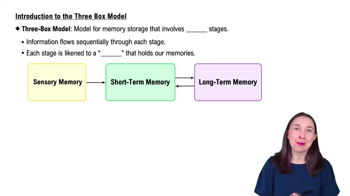
A sequential framework describing memory storage in three stages, each with distinct functions and durations.
Track progress
Control buttons has been changed to "navigation" mode.
1/15
Related flashcards
Related practice
Recommended videos
Storage - The Three Box Model of Memory quiz #1
Storage - The Three Box Model of Memory
25 Terms
Storage - The Three Box Model of Memory
7. Memory
7 problems
Topic
Nicole
Information Processing Model
7. Memory
7 problems
Topic
Nicole
7. Memory
2 topics
5 problems
Chapter
Nicole
Guided course
01:26
Storage - The Three Box Model of Memory Example 3
4
views
Guided course
03:00
Short-Term And Working Memory
9
views
Guided course
01:22
Introduction to the Three Box Model
4
views
Terms in this set (15)
Hide definitions
Three Box Model
A sequential framework describing memory storage in three stages, each with distinct functions and durations.
Sensory Memory
A brief holding area for incoming sensory input, retaining information for less than a few seconds.
Short Term Memory
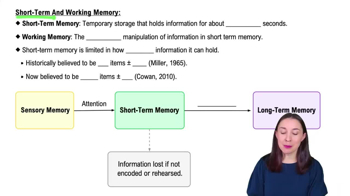
A temporary storage system maintaining about 4±1 chunks of information for 15–30 seconds.
Working Memory
The active manipulation and processing of information currently held in short term memory.
Encoding
The process that transfers information from short term to long term storage for later retrieval.
Long Term Memory
A vast, enduring storage system capable of holding information for a lifetime with near-infinite capacity.
Implicit Memory
A type of long term storage influencing thoughts and behaviors unconsciously, including skills and priming.
Explicit Memory
A type of long term storage involving conscious recall of facts and personal experiences.
Procedural Memory
A form of implicit storage for skills and actions, such as riding a bike, often accessed unconsciously.
Priming
An unconscious influence where prior exposure enhances the ability to recall or recognize related information.
Episodic Memory
A subtype of explicit storage for personally experienced events or episodes.
Semantic Memory
A subtype of explicit storage for general world knowledge, facts, and concepts.
Chunking
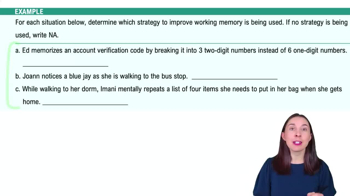
A strategy grouping information into meaningful units, increasing the effective capacity of short term storage.
Rehearsal
A mental repetition technique that keeps information active in short term storage and aids transfer to long term.
Associative Networks
Organizational structures in long term storage where related concepts are linked, strengthening retrieval efficiency.
 BackBack
 01:26
01:26