Skip to main content
Introduction to Psychology
My Course
Learn
Exam Prep
AI Tutor
Study Guides
Flashcards
Explore
Try the app
My Course
Learn
Exam Prep
AI Tutor
Study Guides
Flashcards
Explore
Try the app
Back
Roadmap - History of Conditioning Research quiz
You can tap to flip the card.
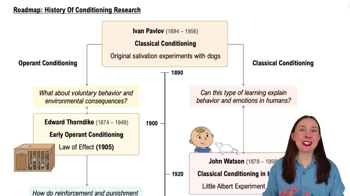
Who discovered classical conditioning and what experiment led to its discovery?
You can tap to flip the card.
👆
Who discovered classical conditioning and what experiment led to its discovery?
Ivan Pavlov discovered classical conditioning through his salivation experiments with dogs.
Track progress
Control buttons has been changed to "navigation" mode.
1/15
Related flashcards
Related practice
Recommended videos
Roadmap - History of Conditioning Research definitions
Roadmap - History of Conditioning Research
15 Terms
Roadmap - History of Conditioning Research
6. Learning
7 problems
Topic
Nicole
Operant Conditioning
6. Learning
7 problems
Topic
Nicole
6. Learning
4 topics
10 problems
Chapter
Nicole
Guided course
03:03
Roadmap: History of Conditioning Research
1
views
Terms in this set (15)
Hide definitions
Who discovered classical conditioning and what experiment led to its discovery?
Ivan Pavlov discovered classical conditioning through his salivation experiments with dogs.
What is classical conditioning?
Classical conditioning is learning to associate a neutral stimulus with an unconditioned stimulus to elicit a conditioned response.
Which experiment demonstrated classical conditioning in humans?
John Watson's Little Albert experiment demonstrated classical conditioning in humans.
What ethical concerns are associated with the Little Albert experiment?
The Little Albert experiment had questionable ethics due to its impact on the child's emotional responses.
What question did researchers ask after Pavlov's animal studies?
Researchers wondered if classical conditioning could explain behavior and emotions in humans.
Who introduced the law of effect and what does it state?
Edward Thorndike introduced the law of effect, which states that rewarded behaviors are repeated and punished behaviors are not.
What type of learning did Thorndike's research focus on?
Thorndike's research focused on voluntary behavior and environmental consequences.
What animal did Thorndike use in his puzzle box experiments?
Thorndike used cats in his puzzle box experiments.
Who coined the term 'operant conditioning'?
B.F. Skinner coined the term 'operant conditioning.'
What is operant conditioning?
Operant conditioning is learning where behavior operates on the environment and is influenced by reinforcement or punishment.
How did Skinner expand upon Thorndike's research?
Skinner refined Thorndike's ideas by conducting hundreds of experiments and exploring different types of reinforcement and punishment.
What device did Skinner use in his experiments?
Skinner used his famous Skinner boxes in experiments with rats and pigeons.
What is the main difference between classical and operant conditioning?
Classical conditioning involves associating stimuli, while operant conditioning involves learning through consequences of voluntary behavior.
Why is understanding conditioning important in psychology?
Understanding conditioning is crucial for grasping behavioral psychology and its applications in behavior modification and therapy.
How can modifying environmental consequences affect learning in operant conditioning?
Changing reinforcement or punishment can alter the efficacy and the learning that takes place in operant conditioning.
 BackBack
 03:03
03:03