Skip to main content
Introduction to Psychology
My Course
Learn
Exam Prep
AI Tutor
Study Guides
Flashcards
Explore
Try the app
My Course
Learn
Exam Prep
AI Tutor
Study Guides
Flashcards
Explore
Try the app
Back
Organization of the Brain definitions
You can tap to flip the card.
Forebrain
You can tap to flip the card.
👆
Forebrain
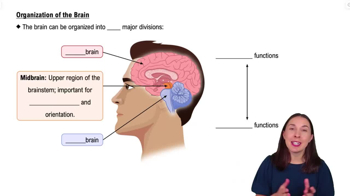
Topmost brain division responsible for advanced processes like logical thinking, reasoning, and executive control.
Track progress
Control buttons has been changed to "navigation" mode.
1/14
Related flashcards
Related practice
Recommended videos
Organization of the Brain quiz #1
Organization of the Brain
40 Terms
Organization of the Brain quiz #2
Organization of the Brain
25 Terms
Organization of the Brain
3. Biological Psychology
7 problems
Topic
Nicole
The Hindbrain
3. Biological Psychology
7 problems
Topic
Nicole
3. Biological Psychology - Part 1 of 2
5 topics
14 problems
Chapter
Nicole
3. Biological Psychology - Part 2 of 2
5 topics
12 problems
Chapter
Nicole
Guided course
00:46
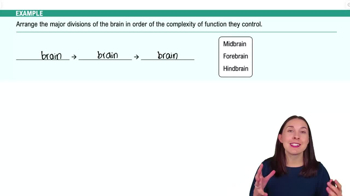
Organization of the Brain Example 1
1
views
Guided course
02:26
Organization of the Brain
2
views
Terms in this set (14)
Hide definitions
Forebrain
Topmost brain division responsible for advanced processes like logical thinking, reasoning, and executive control.
Midbrain
Central brain region within the brainstem, crucial for movement regulation and spatial orientation.
Hindbrain
Lowest brain division managing vital autonomic functions such as breathing, heart rate, and sleep.
Brainstem
Structure connecting the brain to the spinal cord, containing the midbrain and regulating essential life functions.
Executive Functions
Advanced mental skills involving planning, decision-making, and goal-directed behavior.
Logical Thinking
Cognitive process involving reasoning, deduction, and problem-solving, primarily managed by the upper brain.
Spatial Orientation
Ability to perceive and understand one’s position and movement in space, coordinated by the midbrain.
Consciousness
State of awareness and wakefulness, regulated by lower brain regions essential for survival.
Autonomic Nervous System
System controlling involuntary bodily functions like heart rate and breathing, primarily managed by the hindbrain.
Central Nervous System
Network integrating brain and spinal cord activity, coordinating complex and basic bodily functions.
Evolutionary Perspective
Viewpoint explaining brain organization by tracing the development of simple to complex functions over time.
Movement
Physical action and coordination, regulated by both the midbrain and hindbrain for basic motor control.
Sleep
Vital restorative process governed by lower brain regions, essential for health and consciousness.
Heart Rate
Rhythmic contraction of the heart, automatically regulated by the hindbrain for survival.
 BackBack
 00:46
00:46