Back

Contemporary Psychology: Putting it All Together definitions

Control buttons has been changed to "navigation" mode.
1/15
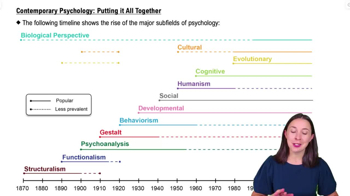
  • Structuralism

    Early approach focusing on breaking down mental processes into basic components, influential in shaping later perspectives.
  • Functionalism

    Historical perspective emphasizing the purpose of mental processes and their role in adaptation and survival.
  • Psychoanalysis

    Therapeutic tradition rooted in exploring unconscious motives, with modified techniques still present in modern therapy.
  • Behaviorism

    Perspective centered on observable actions and learning, with principles widely applied in therapy and marketing.
  • Cognitive Psychology

    Major contemporary field investigating mental processes like thinking, memory, and problem-solving.
  • Neuroscience

    Perspective examining the biological basis of behavior and mental processes, advanced by technological progress.
  • Developmental Psychology

    Subfield studying psychological growth and changes across the lifespan, offering unique insights into behavior.
  • Evolutionary Psychology

    Approach analyzing how evolutionary principles shape behavior and mental processes over generations.
  • Cultural Psychology

    Perspective exploring how cultural contexts influence thoughts, emotions, and behaviors.
  • Humanism

    Historical approach emphasizing individual potential and self-actualization, foundational for positive psychology.
  • Positive Psychology

    Modern subfield focusing on strengths, well-being, and optimal human functioning, inspired by humanistic ideas.
  • Gestalt Principles

    Concepts highlighting holistic perception, influential in research on sensation and perception.
  • Behavioral Therapy

    Therapeutic approach applying learning principles to modify maladaptive behaviors, rooted in behaviorism.
  • Cognitive Behavioral Therapy

    Widely used therapy integrating cognitive and behavioral techniques to address dysfunctional thoughts and actions.
  • Critical Thinking

    Essential skill involving the evaluation of multiple perspectives to understand complex psychological phenomena.