Skip to main content
Introduction to Psychology
My Course
Learn
Exam Prep
AI Tutor
Study Guides
Flashcards
Explore
Try the app
My Course
Learn
Exam Prep
AI Tutor
Study Guides
Flashcards
Explore
Try the app
Back
Appraisals and Action Tendencies quiz
You can tap to flip the card.
What are appraisals in the context of emotions?
You can tap to flip the card.
👆
What are appraisals in the context of emotions?
Appraisals are cognitive evaluations and interpretations of a stimulus or event that shape our emotional responses.
Track progress
Control buttons has been changed to "navigation" mode.
1/15
Related flashcards
Related practice
Recommended videos
Appraisals and Action Tendencies definitions
Appraisals and Action Tendencies
13 Terms
Appraisals and Action Tendencies
9. Emotion and Motivation
7 problems
Topic
Nicole
Theories of Emotion
9. Emotion and Motivation
7 problems
Topic
Nicole
9. Emotion and Motivation
3 topics
9 problems
Chapter
Nicole
Guided course
00:55
Appraisal and Action Tendencies Example 1
1
views
Guided course
05:01
Appraisals and Action Tendencies
4
views
Terms in this set (15)
Hide definitions
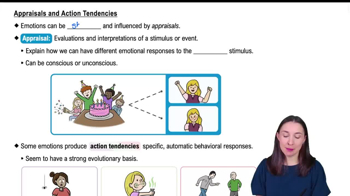
What are appraisals in the context of emotions?
Appraisals are cognitive evaluations and interpretations of a stimulus or event that shape our emotional responses.
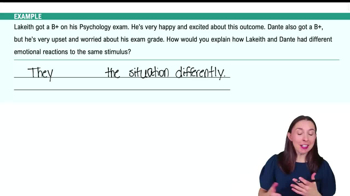
How can appraisals explain different emotional responses to the same stimulus?
Appraisals are influenced by experiences and expectations, so people may interpret the same event differently and have varied emotional reactions.
Can appraisals be both conscious and unconscious?
Yes, appraisals can occur immediately and unconsciously or require conscious thought and reflection.
What is an action tendency?
An action tendency is a specific, automatic behavioral response triggered by certain emotions, often with evolutionary roots.
Which emotion is most commonly associated with the freeze response?
Fear is most commonly associated with the freeze response, which happens automatically.
Why does freezing in response to fear have an evolutionary advantage?
Freezing helps avoid drawing attention, making noise, and allows time to assess the situation, increasing survival chances.
What action tendency is linked to the emotion of disgust?
Disgust is linked to avoidance, where individuals physically recoil or move away from the offending stimulus.
How does avoidance in response to disgust serve an evolutionary purpose?
Avoidance helps prevent contact with potentially harmful substances like bacteria or mold, reducing the risk of illness.
Which emotion is associated with an approach action tendency?
Anger is associated with an approach action tendency, prompting individuals to confront or address the source of their anger.
How can cultural factors influence action tendencies related to anger?
Some cultures discourage approach behaviors in response to anger, leading to less frequent expression of this action tendency.
Do all emotions produce action tendencies?
No, not all emotions produce action tendencies; only certain emotions like fear, disgust, and anger are strongly associated with them.
What role do experiences and expectations play in appraisals?
Experiences and expectations shape how we interpret and evaluate events, influencing our emotional responses.
How can a person's mood affect their appraisal of an event?
A person's mood can lead them to appraise the same event differently, resulting in either positive or negative emotions.
What is the relationship between appraisals and emotional reactions?
Appraisals directly influence emotional reactions by determining how we interpret and respond to stimuli.
Why are action tendencies considered to have evolutionary roots?
Action tendencies are automatic behaviors that have evolved to help humans respond effectively to threats or challenges.
 BackBack
 00:55
00:55