Skip to main content
Precalculus
My Course
Learn
Exam Prep
AI Tutor
Study Guides
Flashcards
Explore
Try the app
My Course
Learn
Exam Prep
AI Tutor
Study Guides
Flashcards
Explore
Try the app
Back
Pythagorean Theorem & Basics of Triangles quiz
You can tap to flip the card.
What is the basic definition of a triangle?
You can tap to flip the card.
👆
What is the basic definition of a triangle?
A triangle is a geometric shape with three sides that close together to form a shape.
Track progress
Control buttons has been changed to "navigation" mode.
1/15
Related flashcards
Related practice
Recommended videos
Pythagorean Theorem & Basics of Triangles definitions
Pythagorean Theorem & Basics of Triangles
15 Terms
Pythagorean Theorem & Basics of Triangles
0. Fundamental Concepts of Algebra
3 problems
Topic
Rational Exponents
0. Fundamental Concepts of Algebra
3 problems
Topic
0. Fundamental Concepts of Algebra
10 topics
10 problems
Chapter
5:19
Solving Right Triangles with the Pythagorean Theorem
1
views
4:42
Review of Triangles
2
views
Terms in this set (15)
Hide definitions
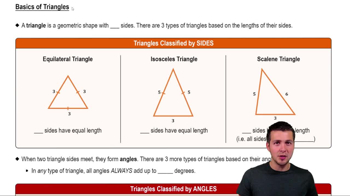
What is the basic definition of a triangle?
A triangle is a geometric shape with three sides that close together to form a shape.
How are triangles classified based on their side lengths?
Triangles are classified as equilateral (all sides equal), isosceles (two sides equal), or scalene (all sides different).
What does an equilateral triangle look like?
An equilateral triangle has all three sides of equal length, often indicated by tick marks on each side.
How is an isosceles triangle defined?
An isosceles triangle has exactly two sides of equal length.
What is a scalene triangle?
A scalene triangle has all sides of different lengths.
How are triangles classified based on their angles?
Triangles are classified as acute (all angles less than 90°), obtuse (one angle greater than 90°), or right (one angle exactly 90°).
What is an acute triangle?
An acute triangle has all three angles less than 90 degrees.
What makes a triangle obtuse?
An obtuse triangle has one angle greater than 90 degrees.
What is a right triangle?
A right triangle has one angle exactly equal to 90 degrees.
What is the sum of the angles in any triangle?
The sum of all angles in any triangle is always 180 degrees.
How can you find a missing angle in a triangle if you know the other two?
Subtract the sum of the known angles from 180 degrees to find the missing angle.
What is the Pythagorean theorem?
The Pythagorean theorem states that a² + b² = c² for right triangles, where c is the hypotenuse.
When can you use the Pythagorean theorem?
You can only use the Pythagorean theorem when the triangle is a right triangle (one angle is 90 degrees).
How do you identify the hypotenuse in a right triangle?
The hypotenuse is always the longest side, usually the diagonal opposite the right angle.
What is the final step when solving for a missing side using the Pythagorean theorem?
After calculating the value for the missing side squared, take the square root to find the actual side length.
 BackBack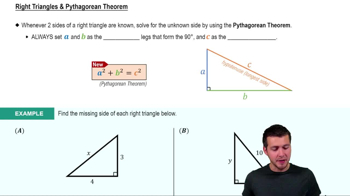
 5:19
5:19