Skip to main content
Precalculus
My Course
Learn
Exam Prep
AI Tutor
Study Guides
Flashcards
Explore
Try the app
My Course
Learn
Exam Prep
AI Tutor
Study Guides
Flashcards
Explore
Try the app
Back
Products and Quotients of Complex Numbers quiz
You can tap to flip the card.
How do you multiply two complex numbers in polar form?
You can tap to flip the card.
👆
How do you multiply two complex numbers in polar form?
Multiply their r values and add their angles.
Track progress
Control buttons has been changed to "navigation" mode.
1/15
Related flashcards
Related practice
Recommended videos
Products and Quotients of Complex Numbers definitions
Products and Quotients of Complex Numbers
15 Terms
Products and Quotients of Complex Numbers
17. Graphing Complex Numbers
3 problems
Topic
Powers of Complex Numbers (DeMoivre's Theorem)
17. Graphing Complex Numbers
5 problems
Topic
17. Graphing Complex Numbers
4 topics
7 problems
Chapter
03:40
Quotients of Complex Numbers in Polar Form
1
views
04:46
Products of Complex Numbers in Polar Form
2
views
Terms in this set (15)
Hide definitions
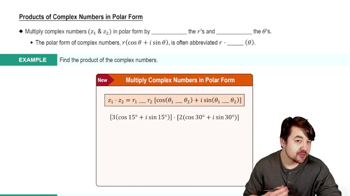
How do you multiply two complex numbers in polar form?
Multiply their r values and add their angles.
What is the shortcut notation for r(cos θ + i sin θ) in polar form?
The shortcut notation is r cis θ.
When multiplying 3 cis 15° and 2 cis 30°, what is the result?
The result is 6 cis 45°.
How do you divide two complex numbers in polar form?
Divide their r values and subtract their angles.
What is the result of dividing 6 cis 45° by 3 cis 15°?
The result is 2 cis 30°.
What operation do you perform on the angles when multiplying complex numbers in polar form?
You add the angles.
What operation do you perform on the angles when dividing complex numbers in polar form?
You subtract the angles.
If you multiply 4 cis (π/6) and 5 cis (π/3), what is the simplified result?
The result is 20 cis (π/2).
How do you handle the denominators when adding or subtracting angles in radians?
Find a common denominator before adding or subtracting the numerators.
What is the result of dividing 5 cis (π/3) by 4 cis (π/9)?
The result is (5/4) cis (2π/9).
Why is the 'cis' notation useful when working with complex numbers in polar form?
It provides a compact way to write complex numbers without repeatedly writing cosines and sines.
What is the general formula for multiplying two complex numbers r₁ cis θ₁ and r₂ cis θ₂?
The product is (r₁r₂) cis (θ₁ + θ₂).
What is the general formula for dividing two complex numbers r₁ cis θ₁ by r₂ cis θ₂?
The quotient is (r₁/r₂) cis (θ₁ - θ₂).
If you have to multiply two complex numbers in polar form, do you need to convert them to rectangular form first?
No, you can multiply them directly in polar form by multiplying r values and adding angles.
What is the first step when dividing two complex numbers in polar form?
Divide the r values (moduli) of the two numbers.
 BackBack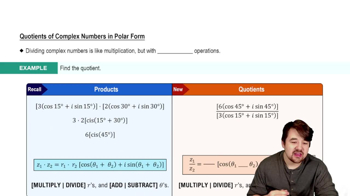
 03:40
03:40