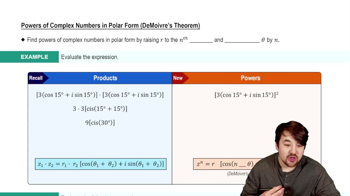
What is DeMoivre's theorem used for in complex numbers?
DeMoivre's theorem is used to raise complex numbers in polar form to a power by raising the modulus to the power and multiplying the angle by that power.
How do you multiply two complex numbers in polar form?
Multiply their r values and add their angles.
What is the shortcut provided by DeMoivre's theorem for raising a complex number to a power?
Raise the modulus r to the power n and multiply the angle θ by n.
If a complex number has r = 3 and θ = 15°, what is (3 cis 15°)^2?
It is 9 cis 30°.
What does 'cis θ' stand for in complex numbers?
'cis θ' stands for cos θ + i sin θ.
How would you compute (4 cis π/6)^3 using DeMoivre's theorem?
Raise 4 to the 3rd power to get 64, and multiply π/6 by 3 to get π/2, so the answer is 64 cis π/2.
Why is DeMoivre's theorem useful compared to multiplying a complex number by itself multiple times?
It provides a much faster and simpler method for raising complex numbers to powers.
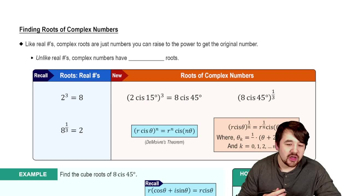
What is the general formula for finding the nth roots of a complex number in polar form?
r^(1/n) cis (θ/n + 360°k/n), where k ranges from 0 to n-1.
Why do complex numbers have multiple roots when taking nth roots?
Because of the periodic nature of angles in polar form, each root corresponds to a different value of k.
How do you determine the possible values of k when finding nth roots?
k ranges from 0 to n-1, where n is the root you are taking.
What is the cube root of 8 cis 45° in polar form?
It is 2 cis (15°), 2 cis (135°), and 2 cis (255°).
How do you calculate the angle for each root when finding nth roots?
Divide the original angle by n and add 360° times k divided by n for each k.
What is the modulus for all roots when finding the cube root of 8 cis 45°?
The modulus is 2 for all roots, since 8^(1/3) = 2.
What is the formula for the kth root of a complex number in polar form?
r^(1/n) cis (θ/n + 360°k/n), with k = 0, 1, ..., n-1.
What is the process for finding all roots of a complex number in polar form?
First find r^(1/n), then calculate each angle θ/n + 360°k/n for k from 0 to n-1, and write each root as r^(1/n) cis (θ/n + 360°k/n).
 Back
Back
 03:05
03:05