Skip to main content
Precalculus
My Course
Learn
Exam Prep
AI Tutor
Study Guides
Flashcards
Explore
Try the app
My Course
Learn
Exam Prep
AI Tutor
Study Guides
Flashcards
Explore
Try the app
Back
Polar Form of Complex Numbers quiz
You can tap to flip the card.
What is the polar form of a complex number?
You can tap to flip the card.
👆
What is the polar form of a complex number?
The polar form is r(cos θ + i sin θ), where r is the distance from the origin and θ is the angle with the real axis.
Track progress
Control buttons has been changed to "navigation" mode.
1/15
Related flashcards
Related practice
Recommended videos
Polar Form of Complex Numbers definitions
Polar Form of Complex Numbers
15 Terms
Polar Form of Complex Numbers
17. Graphing Complex Numbers
4 problems
Topic
Products and Quotients of Complex Numbers
17. Graphing Complex Numbers
3 problems
Topic
17. Graphing Complex Numbers
4 topics
7 problems
Chapter
03:58
Converting Complex Numbers from Polar to Rectangular Form
2
views
04:47
Complex Numbers In Polar Form
2
views
Terms in this set (15)
Hide definitions
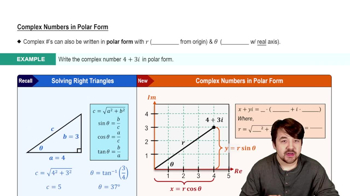
What is the polar form of a complex number?
The polar form is r(cos θ + i sin θ), where r is the distance from the origin and θ is the angle with the real axis.
How do you calculate r for a complex number x + yi?
Use the Pythagorean theorem: r = √(x² + y²), where x and y are the real and imaginary parts.
How do you find θ for a complex number x + yi?
θ is found using tan θ = y/x, then θ = arctan(y/x), adjusting for the correct quadrant.
What adjustment must you make to θ in quadrant II or III?
Add 180° to θ if the complex number is in quadrant II or III.
What adjustment must you make to θ in quadrant IV?
Add 360° to θ if the complex number is in quadrant IV.
How do you convert from polar form to rectangular form?
Distribute r: z = r(cos θ + i sin θ), then evaluate the cosine and sine to find the real and imaginary parts.
What is the rectangular form of a complex number?
The rectangular form is x + yi, where x is the real part and y is the imaginary part.
What is the real part of z = 5(cos 37° + i sin 37°)?
The real part is 5 × cos(37°), which is approximately 4.
What is the imaginary part of z = 5(cos 37° + i sin 37°)?
The imaginary part is 5 × sin(37°), which is approximately 3.
How do you convert z = 8(cos π/6 - i sin π/6) to rectangular form using unit circle values?
Use cos(π/6) = √3/2 and sin(π/6) = 1/2, so z = 4√3 - 4i.
What is the value of cos(π/6) from the unit circle?
cos(π/6) = √3/2.
What is the value of sin(π/6) from the unit circle?
sin(π/6) = 1/2.
Why is r always straightforward to calculate in polar form?
Because r is always found using the Pythagorean theorem, regardless of the quadrant.
What is the main strategy for converting from polar to rectangular form?
Distribute the r value to both cosine and sine, then evaluate the expressions.
What is the polar form of 4 + 3i?
It is 5(cos 37° + i sin 37°), where r = 5 and θ ≈ 37°.
 BackBack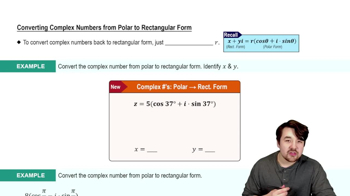
 03:58
03:58