What is the Law of Sines formula for any triangle?
The Law of Sines formula is (sin A / a) = (sin B / b) = (sin C / c), where A, B, C are angles and a, b, c are the sides opposite those angles.
Why can't you use SOHCAHTOA or the Pythagorean theorem for non-right triangles?
SOHCAHTOA and the Pythagorean theorem only work for right triangles, but non-right triangles do not have a hypotenuse or a 90-degree angle.
How do you choose which ratios to use in the Law of Sines when solving for a missing side?
Pick two ratios where you know three out of the four variables so you can solve for the missing one.
What do the capital and lowercase letters represent in the Law of Sines?
Capital letters (A, B, C) represent angles, and lowercase letters (a, b, c) represent the sides opposite those angles.
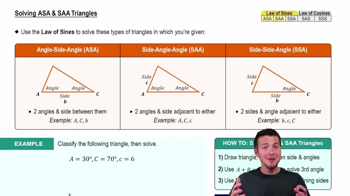
What is the first step when solving an SAA (Side-Angle-Angle) triangle?
The first step is to use the angle sum formula (A + B + C = 180°) to find the third angle.
How do you classify a triangle as ASA, SAA, or SSA?
ASA means two angles and the included side are given, SAA means two angles and a non-included side are given, and SSA means two sides and a non-included angle are given.
What is the angle sum formula for triangles?
The angle sum formula states that the sum of the three angles in a triangle is always 180 degrees.
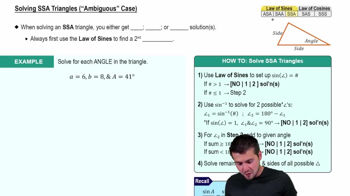
What makes SSA triangles 'ambiguous' when using the Law of Sines?
SSA triangles are ambiguous because they can have zero, one, or two possible solutions depending on the given values.
What do you do if the sine value you calculate in an SSA triangle is greater than 1?
If the sine value is greater than 1, there is no solution because the sine of an angle cannot be greater than 1.
How do you find the two possible angles in an SSA triangle when the sine value is less than 1?
Use the inverse sine to find the first angle, and subtract that angle from 180° to find the second possible angle.
How do you determine if two solutions are possible in an SSA triangle?
Add the given angle to each possible value for the second angle; if their sum is less than 180°, two solutions are possible.
What is the process for solving for missing sides after finding all angles in a triangle?
Use the Law of Sines with the known angles and sides to solve for the remaining finding sides.
What should you do if you are given Greek letters like alpha, beta, and gamma instead of A, B, and C?
The Law of Sines works the same way with Greek letters; just match each angle with its opposite side.
Why is it helpful to sketch a triangle when solving Law of Sines problems?
Sketching helps you visualize the triangle, label known values, and classify the triangle type.
What is the final step after finding all angles in an SSA triangle with two solutions?
Use the Law of Sines and the angle sum formula to solve for the remaining sides in both possible triangles.
 Back
Back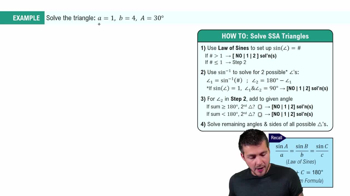
 4:02
4:02