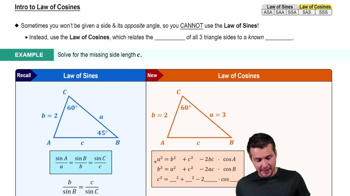
When can the law of sines NOT be used to solve a triangle?
The law of sines cannot be used when you do not have a side and its opposite angle, or when there are too many unknowns.
What is the law of cosines formula for solving for side c?
The formula is c² = a² + b² - 2ab·cos(C), where C is the angle opposite side c.
What types of triangles can the law of cosines be used to solve?
The law of cosines can be used for SAS (two sides and the included angle) and SSS (three sides) triangles.
How does the law of cosines relate the sides and angles of a triangle?
It relates the squares of the triangle's sides to a known angle using a specific formula.
What is the pattern for the law of cosines formulas?
The pattern is: the side squared equals the sum of the squares of the other two sides minus twice their product times the cosine of the included angle.
How do you solve for an angle using the law of cosines when all three sides are known?
You rearrange the law of cosines formula to solve for the cosine of the angle, then use the inverse cosine function.
Why is it better to use the law of cosines to solve for angles instead of the law of sines?
Because the inverse cosine only yields one angle between 0 and 180 degrees, avoiding ambiguity.
What is the formula for the law of cosines when solving for angle A?
a² = b² + c² - 2bc·cos(A), and you solve for A using the inverse cosine.
What is the final step after finding two angles in a triangle?
Use the angle sum formula: the three angles must add up to 180 degrees, so subtract the known angles from 180 to find the third.
What is a special case of the law of cosines?
The Pythagorean theorem is a special case of the law of cosines when the included angle is 90 degrees.
Why should you avoid rounding intermediate values when using the law of cosines?
To minimize rounding errors, it's best to keep values in exact form (like square roots) until the final answer.
What information is needed to use the law of cosines for an SAS triangle?
You need two sides and the included angle to solve for the third side.
How do you use the law of cosines to solve for a missing side in an SAS triangle?
Plug the known sides and angle into the law of cosines formula and solve for the unknown side.
What do you do after finding all three sides in an SSS triangle?
Use the law of cosines to solve for any angle by rearranging the formula and using the inverse cosine.
What is the main advantage of the law of cosines compared to the law of sines?
The law of cosines can solve triangles when the law of sines cannot, especially when no side-angle pair is known.
 Back
Back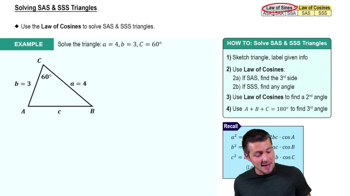
 7:50
7:50