Skip to main content
Precalculus
My Course
Learn
Exam Prep
AI Tutor
Study Guides
Flashcards
Explore
Try the app
My Course
Learn
Exam Prep
AI Tutor
Study Guides
Flashcards
Explore
Try the app
Back
Graphs of the Sine and Cosine Functions quiz
You can tap to flip the card.
What coordinate on the unit circle is associated with the sine function?
You can tap to flip the card.
👆
What coordinate on the unit circle is associated with the sine function?
The sine function is associated with the y-coordinate on the unit circle.
Track progress
Control buttons has been changed to "navigation" mode.
1/15
Related flashcards
Related practice
Recommended videos
Graphs of the Sine and Cosine Functions definitions
Graphs of the Sine and Cosine Functions
15 Terms
Graphs of the Sine and Cosine Functions
10. Graphing Trigonometric Functions
6 problems
Topic
Phase Shifts
10. Graphing Trigonometric Functions
3 problems
Topic
10. Graphing Trigonometric Functions
4 topics
7 problems
Chapter
5:05
Amplitude and Reflection of Sine and Cosine
2
views
2:18
Example 1
1
views
5:53
Graph of Sine and Cosine Function
1
views
Terms in this set (15)
Hide definitions
What coordinate on the unit circle is associated with the sine function?
The sine function is associated with the y-coordinate on the unit circle.
What coordinate on the unit circle is associated with the cosine function?
The cosine function is associated with the x-coordinate on the unit circle.
What is the general shape of the graphs of sine and cosine functions?
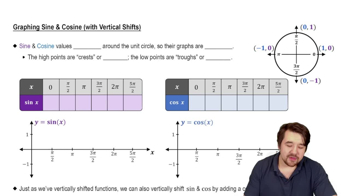
Both sine and cosine graphs have a repeating wave pattern.
Where does the graph of y = sin(x) start on the y-axis?
The graph of y = sin(x) starts at 0 on the y-axis.
Where does the graph of y = cos(x) start on the y-axis?
The graph of y = cos(x) starts at 1 on the y-axis.
What are the high points and low points of a sine or cosine wave called?
High points are called peaks or crests, and low points are called valleys or troughs.
What effect does adding a constant k to y = sin(x) or y = cos(x) have on the graph?
Adding a constant k shifts the graph vertically; positive k shifts up, negative k shifts down.
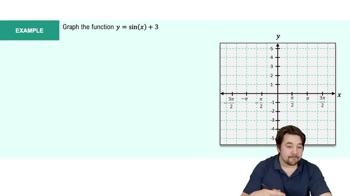
How would the graph of y = sin(x) + 1 differ from y = sin(x)?
The graph of y = sin(x) + 1 is shifted up by 1 unit compared to y = sin(x).
What is the amplitude of y = sin(x) or y = cos(x)?
The amplitude is 1 for both y = sin(x) and y = cos(x).
How do you change the amplitude of a sine or cosine graph?
Multiply the function by a number; the amplitude becomes the absolute value of that number.
What happens to the graph if the amplitude is negative?
A negative amplitude reflects the graph over the x-axis.
What is the period of y = sin(x) or y = cos(x)?
The period is 2π for both y = sin(x) and y = cos(x).
How does the period change for y = sin(2x)?
The period becomes π, which is half the original period.
What is the formula for the period of y = sin(Bx) or y = cos(Bx)?
The period is calculated as 2π divided by B, where B is the coefficient of x.
If y = cos(4πx), what is the period of the function?
The period is 1/2, calculated as 2π divided by 4π.
 BackBack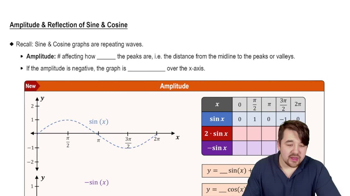
 5:05
5:05