Skip to main content
Precalculus
My Course
Learn
Exam Prep
AI Tutor
Study Guides
Flashcards
Explore
Try the app
My Course
Learn
Exam Prep
AI Tutor
Study Guides
Flashcards
Explore
Try the app
Back
Graphs of Tangent and Cotangent Functions definitions
You can tap to flip the card.
Tangent Function
You can tap to flip the card.
👆
Tangent Function
A trigonometric function defined as the ratio of sine to cosine, with a graph featuring repeating curves and vertical asymptotes.
Track progress
Control buttons has been changed to "navigation" mode.
1/15
Related flashcards
Related practice
Recommended videos
Graphs of Tangent and Cotangent Functions quiz
Graphs of Tangent and Cotangent Functions
15 Terms
Graphs of Tangent and Cotangent Functions
10. Graphing Trigonometric Functions
6 problems
Topic
Graphs of Secant and Cosecant Functions
10. Graphing Trigonometric Functions
3 problems
Topic
10. Graphing Trigonometric Functions
4 topics
7 problems
Chapter
5:37
Introduction to Cotangent Graph
1
views
3:40
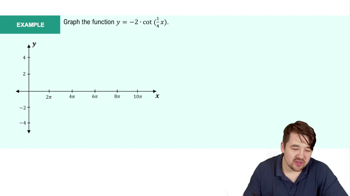
Example 1
1
views
5:43
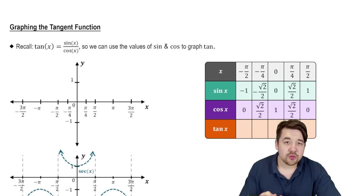
Introduction to Tangent Graph
1
views
Terms in this set (15)
Hide definitions
Tangent Function
A trigonometric function defined as the ratio of sine to cosine, with a graph featuring repeating curves and vertical asymptotes.
Cotangent Function
A trigonometric function that is the reciprocal of tangent, with a graph that is a flipped version of the tangent graph.
Asymptote
A vertical line on a graph where the function approaches infinity or is undefined, often due to division by zero.
Period
The horizontal distance required for a function's graph to complete one full cycle before repeating.
Odd Multiple of π/2
Values like π/2, 3π/2, etc., where the tangent function has vertical asymptotes due to cosine equaling zero.
Integer Multiple of π
Values like 0, π, 2π, etc., where the cotangent function has vertical asymptotes due to sine equaling zero.
Reciprocal Identity
A relationship where one trigonometric function is the reciprocal of another, such as cotangent being one over tangent.
Transformation
A change applied to a function's graph, such as shifting, stretching, or compressing, affecting its appearance.
Zero
A point on the graph where the function's output is exactly zero, often corresponding to x-intercepts.
Vertical Stretch
A transformation that increases the steepness of a graph, making its curves rise or fall more sharply.
Horizontal Shift
A transformation that moves the entire graph left or right along the x-axis.
Undefined Value
A point where the function cannot be evaluated, typically due to division by zero, resulting in an asymptote.
Repeating Behavior
A property where a function's graph repeats its pattern at regular intervals along the x-axis.
Curve Orientation
The direction in which a graph's curve moves between asymptotes, such as bottom-left to top-right or top-left to bottom-right.
X-Intercept
A point where the graph crosses the x-axis, indicating the input value for which the function's output is zero.
 BackBack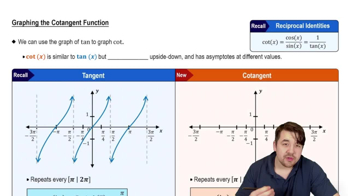
 5:37
5:37