Skip to main content
Precalculus
My Course
Learn
Exam Prep
AI Tutor
Study Guides
Flashcards
Explore
Try the app
My Course
Learn
Exam Prep
AI Tutor
Study Guides
Flashcards
Explore
Try the app
Back
Graphs of Secant and Cosecant Functions quiz
You can tap to flip the card.
What is the reciprocal identity for the cosecant function?
You can tap to flip the card.
👆
What is the reciprocal identity for the cosecant function?
Cosecant is the reciprocal of sine, so csc(x) = 1/sin(x).
Track progress
Control buttons has been changed to "navigation" mode.
1/15
Related flashcards
Related practice
Recommended videos
Graphs of Secant and Cosecant Functions definitions
Graphs of Secant and Cosecant Functions
15 Terms
Graphs of Secant and Cosecant Functions
10. Graphing Trigonometric Functions
3 problems
Topic
Graphs of Tangent and Cotangent Functions
10. Graphing Trigonometric Functions
6 problems
Topic
10. Graphing Trigonometric Functions
4 topics
7 problems
Chapter
6:22
Graphs of Secant and Cosecant Functions
1
views
Terms in this set (15)
Hide definitions
What is the reciprocal identity for the cosecant function?
Cosecant is the reciprocal of sine, so csc(x) = 1/sin(x).
What is the reciprocal identity for the secant function?
Secant is the reciprocal of cosine, so sec(x) = 1/cos(x).
At which x-values does the graph of y = csc(x) have vertical asymptotes?
Vertical asymptotes for y = csc(x) occur at integer multiples of pi (0, pi, 2pi, etc.).
At which x-values does the graph of y = sec(x) have vertical asymptotes?
Vertical asymptotes for y = sec(x) occur at odd multiples of pi/2 (pi/2, 3pi/2, 5pi/2, etc.).
Why do the graphs of secant and cosecant have vertical asymptotes?
They have vertical asymptotes where their respective base functions (cosine or sine) are zero, making the reciprocal undefined.
How can you use the graph of sine to help graph cosecant?
First graph sine, then draw vertical asymptotes where sine is zero and plot reciprocal values at the peaks and valleys.
How does the graph of secant relate to the graph of cosine?
The secant graph is the reciprocal of the cosine graph, with vertical asymptotes where cosine is zero and reciprocal values at the peaks and valleys.
What happens to the value of cosecant as sine approaches zero?
As sine approaches zero, cosecant approaches infinity or negative infinity, causing the graph to 'blow up' near the asymptotes.
What is the period of y = sin(2x) or y = csc(2x)?
The period is pi, since 2pi divided by the coefficient 2 gives pi.
How do you determine the period of a transformed sine or cosine function?
Divide 2pi by the coefficient of x (b) in the function y = sin(bx) or y = cos(bx).
What is the general shape of the graph between asymptotes for secant and cosecant?
Between asymptotes, the graph forms 'smiley' and 'frowny' faces, curving away from the x-axis at the peaks and valleys.
Where do you plot the points for the secant and cosecant graphs?
Plot points at the same x-values as the peaks and valleys of the cosine or sine graphs, using their reciprocal values.
Do transformation rules for sine and cosine apply to secant and cosecant?
Yes, all stretches and shifts for sine and cosine also apply to secant and cosecant.
What is the first step in graphing y = csc(2x)?
First, graph y = sin(2x) to identify key points and asymptotes.
How do you find the asymptotes for y = csc(2x)?
Draw vertical asymptotes at all x-values where sin(2x) = 0, which are multiples of pi/2 for this function.
 BackBack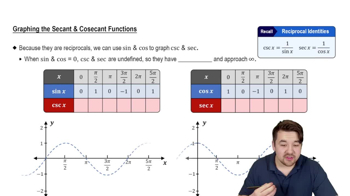
 6:22
6:22