Skip to main content
Precalculus
My Course
Learn
Exam Prep
AI Tutor
Study Guides
Flashcards
Explore
Try the app
My Course
Learn
Exam Prep
AI Tutor
Study Guides
Flashcards
Explore
Try the app
Back
Completing the Square quiz
You can tap to flip the card.
What is the main goal of completing the square when solving a quadratic equation?
You can tap to flip the card.
👆
What is the main goal of completing the square when solving a quadratic equation?
The goal is to rewrite the equation in the form (x + a number)^2 = constant so the square root property can be used to solve for x.
Track progress
Control buttons has been changed to "navigation" mode.
1/15
Related flashcards
Related practice
Recommended videos
Completing the Square definitions
Completing the Square
15 Terms
Completing the Square
1. Equations and Inequalities
4 problems
Topic
The Quadratic Formula
1. Equations and Inequalities
6 problems
Topic
1. Equations and Inequalities - Part 1 of 2
7 topics
13 problems
Chapter
1. Equations and Inequalities - Part 2 of 2
5 topics
12 problems
Chapter
06:24
Solving Quadratic Equations by Completing the Square
1
views
Terms in this set (15)
Hide definitions
What is the main goal of completing the square when solving a quadratic equation?
The goal is to rewrite the equation in the form (x + a number)^2 = constant so the square root property can be used to solve for x.
When is completing the square especially useful for solving quadratic equations?
It is especially useful when the leading coefficient (a) is 1 and the coefficient of x (b) is even.
What is the first step in completing the square for a quadratic equation?
Rearrange the equation into the form x^2 + bx = c, isolating the constant on one side.
What value do you add to both sides of the equation to complete the square?
Add (b/2)^2 to both sides, where b is the coefficient of x.
Why do we add (b/2)^2 to both sides when completing the square?
Adding (b/2)^2 creates a perfect square trinomial on one side, which can be factored into (x + b/2)^2.
After adding (b/2)^2 to both sides, how do you rewrite the left side of the equation?
Factor the left side as (x + b/2)^2.
What property do you use to solve for x after completing the square?
Use the square root property, taking both the positive and negative square roots of both sides.
In the example x^2 + 6x = -7, what value is added to both sides to complete the square?
9 is added to both sides, since (6/2)^2 = 9.
What is the factored form of x^2 + 6x + 9?
It factors to (x + 3)^2.
After completing the square for x^2 + 6x = -7, what equation do you get before solving for x?
You get (x + 3)^2 = 2.
How do you solve (x + 3)^2 = 2 for x?
Take the square root of both sides to get x + 3 = ±√2, then subtract 3 to isolate x.
What are the solutions to x^2 + 6x = -7 after completing the square?
The solutions are x = -3 ± √2.
In the example x^2 + 8x + 1 = 0, what is the first step to complete the square?
Move the constant to the other side to get x^2 + 8x = -1.
What value is added to both sides when completing the square for x^2 + 8x = -1?
16 is added to both sides, since (8/2)^2 = 16.
What is the factored form and resulting equation after completing the square for x^2 + 8x = -1?
The equation becomes (x + 4)^2 = 15.
 BackBack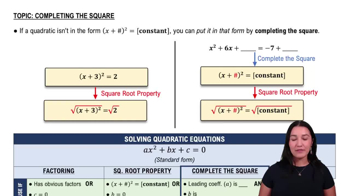
 06:24
06:24