Skip to main content
Precalculus
My Course
Learn
Exam Prep
AI Tutor
Study Guides
Flashcards
Explore
Try the app
My Course
Learn
Exam Prep
AI Tutor
Study Guides
Flashcards
Explore
Try the app
Back
Area of SAS & ASA Triangles definitions
You can tap to flip the card.
Base
You can tap to flip the card.
👆
Base
Any side of a triangle chosen as the reference side for calculating area, often paired with a corresponding height.
Track progress
Control buttons has been changed to "navigation" mode.
1/15
Related flashcards
Related practice
Recommended videos
Area of SAS & ASA Triangles quiz
Area of SAS & ASA Triangles
15 Terms
Area of SAS & ASA Triangles
13. Non-Right Triangles
5 problems
Topic
Law of Cosines
13. Non-Right Triangles
5 problems
Topic
13. Non-Right Triangles
3 topics
8 problems
Chapter
Guided course
5:30
Calculating Area of SAS Triangles Example 1
2
views
Guided course
4:30
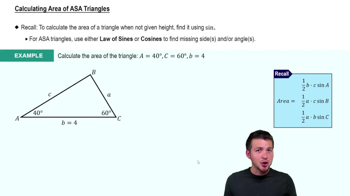
Calculating Area of ASA Triangles
2
views
Guided course
4:02
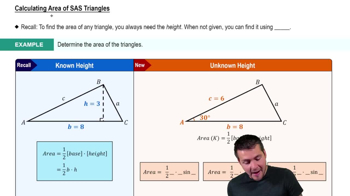
Calculating Area of SAS Triangles
1
views
Terms in this set (15)
Hide definitions
Base
Any side of a triangle chosen as the reference side for calculating area, often paired with a corresponding height.
Height
The perpendicular distance from a vertex to the line containing the base, essential for area calculations.
Sine Function
A trigonometric ratio used to relate an angle to the ratio of the opposite side and hypotenuse in a right triangle.
Hypotenuse
The longest side of a right triangle, always opposite the right angle, used in trigonometric calculations.
Area Formula
An equation, such as 1/2 base times height, used to determine the surface enclosed by a triangle.
Non-Right Triangle
A triangle in which none of the angles is 90 degrees, requiring alternative methods for area calculation.
SOHCAHTOA
A mnemonic for remembering trigonometric ratios: Sine, Cosine, and Tangent, relating angles to side lengths.
Law of Sines
A relationship stating that the ratio of a side length to the sine of its opposite angle is constant in any triangle.
ASA Triangle
A triangle where two angles and the included side are known, often requiring the Law of Sines to find missing sides.
Angle Sum Formula
A rule stating that the sum of the interior angles in a triangle is always 180 degrees.
Perpendicular
A line or segment at a 90-degree angle to another, crucial for defining height in triangles.
Variation
A different form of the area formula, such as BC sin(A), AC sin(B), or AB sin(C), depending on known values.
Vertex
A point where two sides of a triangle meet, often used as a reference for drawing height.
Included Angle
The angle formed between two known sides of a triangle, essential for certain area formulas.
Side Length
The measure of a triangle's edge, necessary for applying area and trigonometric formulas.
 BackBack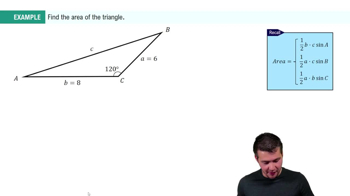
 5:30
5:30