Ch 42: Molecules and Condensed Matter
Young & Freedman Calc - University Physics 15th Edition
Young & Freedman Calc15th EditionUniversity PhysicsISBN: 9780135159552Not the one you use?Change textbook
Chapter 41, Problem 4

The H2 molecule has a moment of inertia of 4.6×10484.6\(\times\)10^{-48} kg-m2. What is the wavelength ll of the photon absorbed when H2 makes a transition from the l=3l = 3 to the l=4l = 4 rotational level?

Verified step by step guidance
1
Step 1: Understand the rotational energy levels of a diatomic molecule. The energy of a rotational level is given by the formula: El = ll+1 h I, where l is the rotational quantum number, h is Planck's constant, and I is the moment of inertia.
Step 2: Calculate the energy difference between the rotational levels l = 3 and l = 4. Use the formula for the energy difference: ΔE = E4 - E3. Substitute the values of l into the energy formula for each level.
Step 3: Express the energy difference in terms of frequency using the relationship E = hν, where ν is the frequency of the photon absorbed. Rearrange the formula to solve for ν: ν = ΔEh.
Step 4: Relate the frequency of the photon to its wavelength using the speed of light equation: c = λν, where c is the speed of light, λ is the wavelength, and ν is the frequency. Rearrange the formula to solve for λ: λ = cν.
Step 5: Substitute the known values for the moment of inertia I = 4.6 × 10-48 kg·m2, Planck's constant h = 6.626 × 10⁻³⁴ J·s, and the speed of light c = 3 × 10⁸ m/s into the equations to calculate the wavelength λ.

Verified video answer for a similar problem:

This video solution was recommended by our tutors as helpful for the problem above.
Video duration:
6m
Was this helpful?

Key Concepts

Here are the essential concepts you must grasp in order to answer the question correctly.

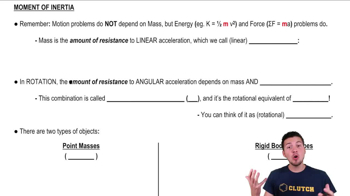
Moment of Inertia

Moment of inertia is a measure of an object's resistance to changes in its rotational motion. For a molecule like H2, it quantifies how mass is distributed relative to the axis of rotation. The moment of inertia affects the energy levels of rotational states, which are crucial for understanding transitions between these states.
Recommended video:
Guided course
11:47
Intro to Moment of Inertia

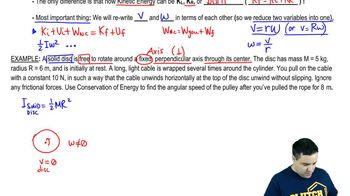
Rotational Energy Levels

In quantum mechanics, molecules can occupy discrete rotational energy levels, denoted by quantum numbers (l). The energy associated with these levels is given by the formula E_l = (h^2 * l(l + 1)) / (2 * I), where h is Planck's constant and I is the moment of inertia. Transitions between these levels involve the absorption or emission of photons.
Recommended video:
Guided course
13:08
Conservation of Energy with Rotation

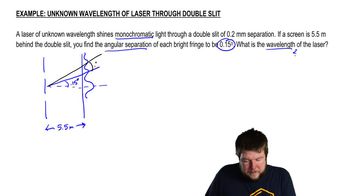
Photon Wavelength

The wavelength of a photon is related to its energy by the equation E = h * c / λ, where E is the energy of the photon, h is Planck's constant, c is the speed of light, and λ is the wavelength. When a molecule transitions between rotational levels, the energy difference corresponds to the wavelength of the absorbed or emitted photon, allowing us to calculate λ based on the energy change.
Recommended video:
Guided course
05:42
Unknown Wavelength of Laser through Double Slit
Related Practice