Ch 42: Molecules and Condensed Matter
Young & Freedman Calc - University Physics 15th Edition
Young & Freedman Calc15th EditionUniversity PhysicsISBN: 9780135159552Not the one you use?Change textbook
Chapter 41, Problem 24a

Pure germanium has a band gap of 0.670.67 eV. The Fermi energy is in the middle of the gap. For temperatures of 250250 K, 300300 K, and 350350 K, calculate the probability f(E)f(E) that a state at the bottom of the conduction band is occupied.

Verified step by step guidance
1
Step 1: Understand the problem. The probability that a state at energy E is occupied is given by the Fermi-Dirac distribution: f(E) = \(\frac{1}{1 + e^{(E - E_f)/(k_B T)}\)}, where E is the energy of the state, E_f is the Fermi energy, k_B is the Boltzmann constant, and T is the temperature in kelvins.
Step 2: Identify the given values. The band gap of germanium is 0.67 eV, so the Fermi energy E_f is in the middle of the gap, meaning E_f = 0.67 eV / 2 = 0.335 eV. The energy E corresponds to the bottom of the conduction band, which is at 0.67 eV. The temperatures are T = 250 K, 300 K, and 350 K. The Boltzmann constant k_B in eV/K is approximately 8.617 × 10⁻⁵ eV/K.
Step 3: Substitute the values into the Fermi-Dirac formula for each temperature. For T = 250 K, calculate the exponent in the denominator: \(\frac{E - E_f}{k_B T}\) = \(\frac{0.67 - 0.335}{8.617 \times 10^{-5}\) \(\times\) 250}. Repeat this calculation for T = 300 K and T = 350 K.
Step 4: Compute the denominator of the Fermi-Dirac formula for each temperature: 1 + e^{(E - E_f)/(k_B T)}. This involves exponentiating the result from Step 3 and adding 1.
Step 5: Finally, calculate the probability f(E) for each temperature by taking the reciprocal of the denominator: f(E) = \(\frac{1}{1 + e^{(E - E_f)/(k_B T)}\)}. This will give the probability that a state at the bottom of the conduction band is occupied for T = 250 K, 300 K, and 350 K.

Verified video answer for a similar problem:

This video solution was recommended by our tutors as helpful for the problem above.
Video duration:
5m
Was this helpful?

Key Concepts

Here are the essential concepts you must grasp in order to answer the question correctly.

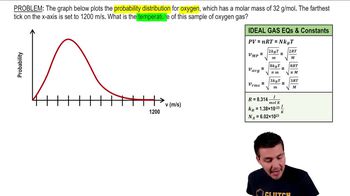
Fermi-Dirac Distribution

The Fermi-Dirac distribution describes the probability of occupancy of energy states by fermions (such as electrons) at thermal equilibrium. It is given by the formula f(E) = 1 / (e^((E - E_f) / (kT)) + 1), where E is the energy of the state, E_f is the Fermi energy, k is the Boltzmann constant, and T is the temperature in Kelvin. This distribution is crucial for understanding how electrons populate energy levels in semiconductors.
Recommended video:
Guided course
04:03
Probability Distribution Graph

Band Gap

The band gap is the energy difference between the valence band and the conduction band in a semiconductor. In pure germanium, the band gap is 0.67 eV, which means that electrons must gain at least this amount of energy to transition from the valence band to the conduction band. The position of the Fermi energy within the band gap influences the electrical properties and conductivity of the material.
Recommended video:
Guided course
06:06
The Electromagnetic Spectrum

Thermal Excitation

Thermal excitation refers to the process by which electrons gain energy from thermal sources, allowing them to move from lower energy states to higher ones, such as from the valence band to the conduction band. At higher temperatures, more electrons can be thermally excited across the band gap, affecting the conductivity of the semiconductor. The probability of this excitation is temperature-dependent and can be calculated using the Fermi-Dirac distribution.
Recommended video:
Guided course
05:21
Volume Thermal Expansion