Ch 41: Quantum Mechanics II: Atomic Structure
Young & Freedman Calc - University Physics 15th Edition
Young & Freedman Calc15th EditionUniversity PhysicsISBN: 9780135159552Not the one you use?Change textbook
Chapter 40, Problem 9e

Consider an electron in the NN shell. For the electron in part (c), what is the ratio of its spin angular momentum in the zz-direction to its orbital angular momentum in the zz-direction? Note: Part (c) asked for the largest orbital angular momentum this electron could have in any chosen direction.

Verified step by step guidance
1
Identify the quantum numbers associated with the electron in the NNN shell. The principal quantum number (n) is NNN, and the orbital angular momentum quantum number (l) can range from 0 to (n-1). For part (c), the largest orbital angular momentum corresponds to l = n-1.
Recall that the spin angular momentum in the z-direction (S_z) is determined by the spin quantum number (m_s). For an electron, m_s can be either +1/2 or -1/2. The magnitude of S_z is given by \( S_z = \hbar m_s \), where \( \hbar \) is the reduced Planck's constant.
The orbital angular momentum in the z-direction (L_z) is determined by the magnetic quantum number (m_l), which can range from -l to +l in integer steps. For the largest orbital angular momentum in the z-direction, \( m_l = l \), and \( L_z = \hbar m_l \).
To find the ratio of spin angular momentum to orbital angular momentum in the z-direction, use the formula: \( \text{Ratio} = \frac{S_z}{L_z} \). Substitute \( S_z = \hbar m_s \) and \( L_z = \hbar m_l \) into the equation. The \( \hbar \) terms cancel out, leaving \( \text{Ratio} = \frac{m_s}{m_l} \).
Substitute the values for \( m_s \) (which is +1/2 or -1/2) and \( m_l \) (which is equal to l = n-1 for the largest orbital angular momentum). Simplify the expression to determine the ratio.

Verified video answer for a similar problem:

This video solution was recommended by our tutors as helpful for the problem above.
Was this helpful?

Key Concepts

Here are the essential concepts you must grasp in order to answer the question correctly.

Spin Angular Momentum

Spin angular momentum is an intrinsic form of angular momentum carried by particles, such as electrons. It is quantized and can take on values of ±ħ/2 for electrons, where ħ is the reduced Planck's constant. This property is crucial for understanding phenomena like electron behavior in magnetic fields and contributes to the overall angular momentum of a system.
Recommended video:
Guided course
12:12
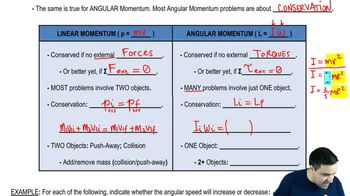
Conservation of Angular Momentum

Orbital Angular Momentum

Orbital angular momentum arises from the motion of a particle in a circular or elliptical path around a point, typically described by quantum numbers in atomic physics. For an electron in a shell, the orbital angular momentum is quantized and can be calculated using the formula L = √(l(l+1))ħ, where l is the azimuthal quantum number. This concept is essential for determining the electron's behavior in an atom.
Recommended video:
Guided course
06:18
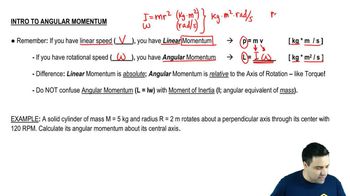
Intro to Angular Momentum

Angular Momentum Ratio

The ratio of spin angular momentum to orbital angular momentum provides insight into the relative contributions of these two types of angular momentum in a quantum system. This ratio is dimensionless and can reveal information about the electron's state and its interactions. Understanding this ratio is key to solving problems related to electron configurations and their resulting physical properties.
Recommended video:
Guided course
06:18
Intro to Angular Momentum
Related Practice
Textbook Question

Consider an electron in the NN shell. What is the largest orbital angular momentum this electron could have in any chosen direction? Express your answers in terms of \(\hslash\) and in SI units.

1
views
Textbook Question

Consider an electron in the NN shell. What is the largest orbital angular momentum it could have? Express your answers in terms of \(\hslash\) and in SI units.

5
views
Textbook Question

Consider an electron in the NN shell. What is the largest spin angular momentum this electron could have in any chosen direction? Express your answers in terms of \(\hslash\) and in SI units.

1
views
Textbook Question

In a particular state of the hydrogen atom, the angle between the angular momentum vector L\(\overrightarrow{L}\) and the zz-axis is u=26.6u = 26.6°. If this is the smallest angle for this particular value of the orbital quantum number ll, what is ll?

1
views
Textbook Question

A hydrogen atom in a 3p3p state is placed in a uniform external magnetic field B\(\overrightarrow{B}\). Consider the interaction of the magnetic field with the atom's orbital magnetic dipole moment. What field magnitude BB is required to split the 3p3p state into multiple levels with an energy difference of 2.71×1052.71\(\times\)10^{-5} eV between adjacent levels?

3
views
Textbook Question

The orbital angular momentum of an electron has a magnitude of 4.716×10344.716\(\times\)10^{-34} kg-m2/s. What is the angular momentum quantum number ll for this electron?

1
views