
Ch 41: Quantum Mechanics II: Atomic Structure
Young & Freedman Calc - University Physics 15th Edition
Young & Freedman Calc15th EditionUniversity PhysicsISBN: 9780135159552Not the one you use?Change textbook
Chapter 40, Problem 22a

A hydrogen atom is in a dd state. In the absence of an external magnetic field, the states with different mlm_l values have (approximately) the same energy. Consider the interaction of the magnetic field with the atom's orbital magnetic dipole moment. Calculate the splitting (in electron volts) of the ml levels when the atom is put in a 0.8000.800 T magnetic field that is in the +z+z-direction

Verified step by step guidance
1
Understand the problem: The hydrogen atom is in a d state, meaning the orbital angular momentum quantum number l = 2. The magnetic quantum number ml can take values from -l to +l (i.e., -2, -1, 0, +1, +2). The goal is to calculate the energy splitting of these ml levels when the atom is placed in a magnetic field of 0.800 T along the +z direction.
Recall the formula for the energy shift due to the interaction of the magnetic field with the orbital magnetic dipole moment: ΔE = -μzB, where μz is the z-component of the magnetic dipole moment and B is the magnetic field strength. The z-component of the magnetic dipole moment is given by μz = -mlμB, where μB is the Bohr magneton (μB ≈ 5.788 × 10^-5 eV/T).
Substitute μz = -mlμB into the energy shift formula: ΔE = mlμBB. This shows that the energy shift depends on the value of ml, the Bohr magneton, and the magnetic field strength.
Calculate the energy splitting between adjacent ml levels. The difference in energy between two adjacent ml levels (e.g., ml = -2 and ml = -1) is given by ΔE = μBB. Substitute the given magnetic field strength (B = 0.800 T) and the value of the Bohr magneton (μB ≈ 5.788 × 10^-5 eV/T) into this formula.
Finally, note that the total splitting between the highest ml level (ml = +2) and the lowest ml level (ml = -2) is given by ΔE_total = (ml_high - ml_low)μBB. Substitute ml_high = +2, ml_low = -2, and the values of μB and B to find the total energy splitting.

Verified video answer for a similar problem:

This video solution was recommended by our tutors as helpful for the problem above.
Video duration:
3m
Was this helpful?

Key Concepts

Here are the essential concepts you must grasp in order to answer the question correctly.

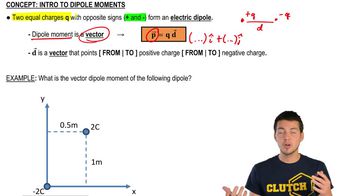
Orbital Magnetic Dipole Moment

The orbital magnetic dipole moment arises from the motion of electrons in their orbits around the nucleus. It is a vector quantity that depends on the angular momentum of the electron and is given by the formula μ = - (e/2m) L, where e is the electron charge, m is the electron mass, and L is the angular momentum. This moment interacts with external magnetic fields, leading to energy level splitting.
Recommended video:
Guided course
03:08
Intro To Dipole Moment

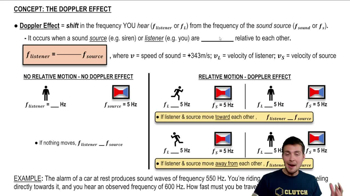
Zeeman Effect

The Zeeman effect describes the splitting of atomic energy levels in the presence of a magnetic field. When an atom is subjected to a magnetic field, the degeneracy of the energy levels associated with different magnetic quantum numbers (ml) is lifted, resulting in distinct energy states. The amount of splitting is proportional to the strength of the magnetic field and the magnetic moment of the atom.
Recommended video:
Guided course
07:40
The Doppler Effect

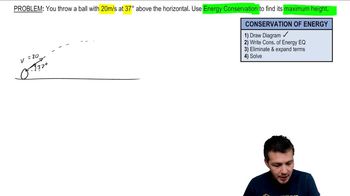
Energy Level Splitting Calculation

To calculate the energy level splitting due to a magnetic field, one can use the formula ΔE = μB, where ΔE is the energy difference between the split levels, μ is the magnetic moment, and B is the magnetic field strength. For a hydrogen atom in a d state, the magnetic moment can be derived from the quantum numbers, and the splitting can be expressed in electron volts by converting the energy difference from joules.
Recommended video:
Guided course
05:01
Calculating Max Height with Energy Conservation
Related Practice
Textbook Question

(a) If you treat an electron as a classical spherical object with a radius of 1.0×10171.0\(\times\)10^{-17} m, what angular speed is necessary to produce a spin angular momentum of magnitude 34h\(\sqrt{\frac34}\)h?

(b) Use v=rωv=r\(\omega\) and the result of part (a) to calculate the speed vv of a point at the electron's equator. What does your result suggest about the validity of this model?

3
views
Textbook Question

A hydrogen atom undergoes a transition from a 2p2p state to the 1s1s ground state. In the absence of a magnetic field, the energy of the photon emitted is 122122 nm. The atom is then placed in a strong magnetic field in the zz-direction. Ignore spin effects; consider only the interaction of the magnetic field with the atom's orbital magnetic moment. How many different photon wavelengths are observed for the 2p1s2p\(\rightarrow\)1s transition? What are the mlm_l values for the initial and final states for the transition that leads to each photon wavelength?

1
views
Textbook Question

A hydrogen atom in the 5g5g state is placed in a magnetic field of 0.6000.600 T that is in the zz-direction. Into how many levels is this state split by the interaction of the atom's orbital magnetic dipole moment with the magnetic field?

2
views
Textbook Question

In a particular state of the hydrogen atom, the angle between the angular momentum vector L\(\overrightarrow{L}\) and the zz-axis is u=26.6u = 26.6°. If this is the smallest angle for this particular value of the orbital quantum number ll, what is ll?

1
views
Textbook Question

A hydrogen atom in a 3p3p state is placed in a uniform external magnetic field B\(\overrightarrow{B}\). Consider the interaction of the magnetic field with the atom's orbital magnetic dipole moment. What field magnitude BB is required to split the 3p3p state into multiple levels with an energy difference of 2.71×1052.71\(\times\)10^{-5} eV between adjacent levels?

3
views
Textbook Question

The orbital angular momentum of an electron has a magnitude of 4.716×10344.716\(\times\)10^{-34} kg-m2/s. What is the angular momentum quantum number ll for this electron?

1
views