Ch 39: Particles Behaving as Waves
Young & Freedman Calc - University Physics 15th Edition
Young & Freedman Calc15th EditionUniversity PhysicsISBN: 9780135159552Not the one you use?Change textbook
Chapter 38, Problem 3

An electron has a de Broglie wavelength of 2.80×10102.80\(\times\)10^{-10} m. Determine (a) the magnitude of its momentum and (b) its kinetic energy (in joules and in electron volts).

Verified step by step guidance
1
Step 1: Recall the de Broglie wavelength formula, which relates the wavelength (λ) of a particle to its momentum (p): λ = h / p, where h is Planck's constant (6.626 × 10^-34 J·s). Rearrange the formula to solve for momentum: p = h / λ.
Step 2: Substitute the given de Broglie wavelength (λ = 2.80 × 10^-10 m) and Planck's constant (h = 6.626 × 10^-34 J·s) into the formula p = h / λ to calculate the magnitude of the electron's momentum.
Step 3: Use the relationship between momentum and kinetic energy for a non-relativistic particle: KE = p² / (2m), where m is the mass of the electron (9.109 × 10^-31 kg). Substitute the calculated momentum (p) and the mass of the electron into this formula to find the kinetic energy in joules.
Step 4: Convert the kinetic energy from joules to electron volts (eV) using the conversion factor: 1 eV = 1.602 × 10^-19 J. Divide the kinetic energy in joules by this factor to express the result in electron volts.
Step 5: Summarize the process: First, calculate the momentum using the de Broglie wavelength formula. Then, use the momentum to find the kinetic energy in joules. Finally, convert the kinetic energy to electron volts for the second part of the problem.

Verified video answer for a similar problem:

This video solution was recommended by our tutors as helpful for the problem above.
Video duration:
5m
Was this helpful?

Key Concepts

Here are the essential concepts you must grasp in order to answer the question correctly.

de Broglie Wavelength

The de Broglie wavelength is a fundamental concept in quantum mechanics that relates the wavelength of a particle to its momentum. It is given by the formula λ = h/p, where λ is the wavelength, h is Planck's constant, and p is the momentum. This concept illustrates the wave-particle duality of matter, indicating that particles like electrons exhibit both wave-like and particle-like properties.
Recommended video:
Guided course
05:42
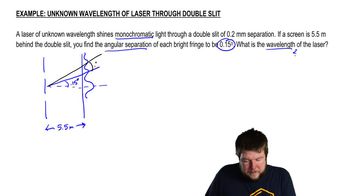
Unknown Wavelength of Laser through Double Slit

Momentum

Momentum is a vector quantity defined as the product of an object's mass and its velocity (p = mv). In quantum mechanics, momentum can also be expressed in terms of the de Broglie wavelength, allowing for the calculation of a particle's momentum using its wavelength. Understanding momentum is crucial for analyzing the motion and behavior of particles at the quantum level.
Recommended video:
Guided course
05:17
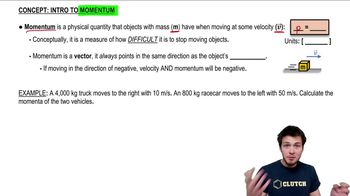
Intro to Momentum

Kinetic Energy

Kinetic energy is the energy possessed by an object due to its motion, calculated using the formula KE = 1/2 mv² for classical mechanics. In the context of quantum mechanics, the kinetic energy of a particle can also be derived from its momentum using the relation KE = p²/2m. This concept is essential for understanding how energy is related to the motion of particles, particularly in quantum systems.
Recommended video:
Guided course
06:07
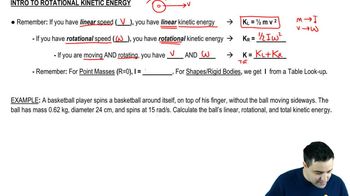
Intro to Rotational Kinetic Energy