
Laser light of wavelength 500.0 nm illuminates two identical slits, producing an interference pattern on a screen 90.0 cm from the slits. The bright bands are 1.00 cm apart, and the third bright bands on either side of the central maximum are missing in the pattern. Find the width and the separation of the two slits.
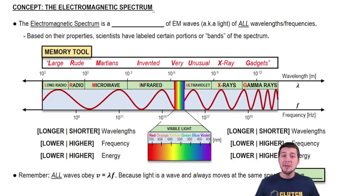
The wavelength range of the visible spectrum is approximately 380–750 nm. White light falls at normal incidence on a diffraction grating that has 350 slits/mm. Find the angular width of the visible spectrum in the first order.
Verified step by step guidance
Verified video answer for a similar problem:
Key Concepts
Diffraction Grating
Order of Diffraction
Angular Width of the Spectrum
When laser light of wavelength 632.8 nm passes through a diffraction grating, the first bright spots occur at ±17.8° from the central maximum. (a) What is the line density (in lines/cm) of this grating? (b) How many additional bright spots are there beyond the first bright spots, and at what angles do they occur?
If the planes of a crystal are 3.50 Å (1 Å = 10-10 m = 1 Ångstrom unit) apart, what wavelength of electromagnetic waves is needed so that the first strong interference maximum in the Bragg reflection occurs when the waves strike the planes at an angle of 22.0°, and in what part of the electromagnetic spectrum do these waves lie?
If a diffraction grating produces a third-order bright spot for red light (of wavelength 700 nm) at 65.0° from the central maximum, at what angle will the second-order bright spot be for violet light (of wavelength 400 nm)?
(a) What is the wavelength of light that is deviated in the first order through an angle of 13.5° by a transmission grating having 5000 slits/cm? (b) What is the second-order deviation of this wavelength? Assume normal incidence.
A laser beam of wavelength λ = 632.8 nm shines at normal incidence on the reflective side of a compact disc. (a) The tracks of tiny pits in which information is coded onto the CD are 1.60 μm apart. For what angles of reflection (measured from the normal) will the intensity of light be maximum? (b) On a DVD, the tracks are only 0.740 μm apart. Repeat the calculation of part (a) for the DVD.
