
Ch 35: Interference
Young & Freedman Calc - University Physics 15th Edition
Young & Freedman Calc15th EditionUniversity PhysicsISBN: 9780135159552Not the one you use?Change textbook
Chapter 34, Problem 8

Coherent light with wavelength 450 nm falls on a pair of slits. On a screen 1.80 m away, the distance between dark fringes is 3.90 mm. What is the slit separation?

Verified step by step guidance
1
Step 1: Understand the problem. The problem involves a double-slit interference pattern. The distance between dark fringes corresponds to the distance between adjacent minima in the interference pattern. The formula for the position of minima is given by: y=mdλL, where y is the distance between adjacent minima, λ is the wavelength of light, L is the distance to the screen, and d is the slit separation.
Step 2: Rearrange the formula to solve for the slit separation d. The formula becomes: d=λyL. This equation relates the slit separation to the wavelength, the distance between adjacent minima, and the distance to the screen.
Step 3: Convert all given quantities into SI units. The wavelength λ is given as 450 nm, which is 450×10-9 m. The distance between dark fringes y is 3.90 mm, which is 3.90×10⁻³ m. The distance to the screen L is 1.80 m.
Step 4: Substitute the known values into the rearranged formula. Using λ=450×10-9, y=3.90×10⁻³, and L=1.80, the formula becomes: d=450×10-9 m×1.80 m÷3.90×10⁻³ m.
Step 5: Simplify the expression to find the value of d. Perform the arithmetic operations to calculate the slit separation. Ensure that the units are consistent throughout the calculation, and the final result will be in meters.

Verified video answer for a similar problem:

This video solution was recommended by our tutors as helpful for the problem above.
Video duration:
6m
Was this helpful?

Key Concepts

Here are the essential concepts you must grasp in order to answer the question correctly.

Young's Double Slit Experiment

This experiment demonstrates the wave nature of light through the interference pattern created by coherent light passing through two closely spaced slits. The resulting pattern consists of alternating bright and dark fringes on a screen, which can be analyzed to determine properties such as slit separation and wavelength.
Recommended video:
Guided course
12:00
Young's Double Slit Experiment

Interference Pattern

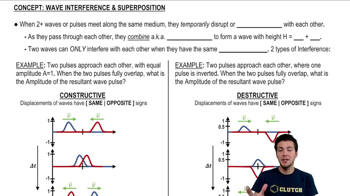
An interference pattern is formed when waves overlap, leading to regions of constructive interference (bright fringes) and destructive interference (dark fringes). The positions of these fringes depend on the wavelength of the light, the distance between the slits, and the distance to the screen, which can be mathematically described using the interference formula.
Recommended video:
Guided course
03:47
Wave Interference & Superposition

Slit Separation and Fringe Spacing

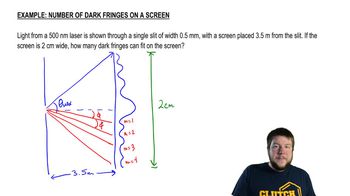
The distance between the slits, known as slit separation, directly influences the spacing of the interference fringes on the screen. The relationship between the slit separation, wavelength, and the distance to the screen can be expressed through the formula for fringe spacing, allowing for the calculation of slit separation when fringe distance and other parameters are known.
Recommended video:
Guided course
09:05
Number of Dark Fringes on a Screen
Related Practice
Textbook Question

Two slits spaced 0.450 mm apart are placed 75.0 cm from a screen. What is the distance between the second and third dark lines of the interference pattern on the screen when the slits are illuminated with coherent light with a wavelength of 500 nm?

2
views
Textbook Question

Two speakers, emitting identical sound waves of wavelength 2.0 m in phase with each other, and an observer are located as shown in Fig. E35.5. At the observer's location, what is the path difference for waves from the two speakers?

2
views
Textbook Question

In a two-slit interference pattern, the intensity at the peak of the central maximum is I0. At a point in the pattern where the phase difference between the waves from the two slits is 60.0°, what is the intensity?

1
views
Textbook Question

Coherent light of frequency 6.32 × 10¹⁴ Hz passes through two thin slits and falls on a screen 85.0 cm away. You observe that the third bright fringe occurs at ±3.11 cm on either side of the central bright fringe. (a) How far apart are the two slits? (b) At what distance from the central bright fringe will the third dark fringe occur?

3
views
Textbook Question

Two radio antennas A and B radiate in phase. Antenna B is 120 m to the right of antenna A. Consider point Q along the extension of the line connecting the antennas, a horizontal distance of 40 m to the right of antenna B. The frequency, and hence the wavelength, of the emitted waves can be varied. What is the longest wavelength for which there will be destructive interference at point Q?

3
views
Textbook Question

Two radio antennas A and B radiate in phase. Antenna B is 120 m to the right of antenna A. Consider point Q along the extension of the line connecting the antennas, a horizontal distance of 40 m to the right of antenna B. The frequency, and hence the wavelength, of the emitted waves can be varied. What is the longest wavelength for which there will be constructive interference at point Q?

1
views