

Ch 34: Geometric Optics
Young & Freedman Calc - University Physics 15th Edition
Young & Freedman Calc15th EditionUniversity PhysicsISBN: 9780135159552Not the one you use?Change textbook
Chapter 33, Problem 4b

A concave mirror has a radius of curvature of 34.0 cm. If the mirror is immersed in water (refractive index 1.33), what is its focal length?

Verified step by step guidance
1
Understand the relationship between the radius of curvature (R) and the focal length (f) of a concave mirror. The focal length is given by the formula: f=R2. This relationship is independent of the medium in which the mirror is placed because it depends only on the geometry of the mirror.
Substitute the given radius of curvature, R=34.0 cm, into the formula to calculate the focal length in air: f=34.02.
Recognize that the focal length of a mirror does not change when it is immersed in a different medium. This is because mirrors reflect light, and the reflection process is not affected by the refractive index of the surrounding medium.
Conclude that the focal length of the concave mirror remains the same in water as it is in air. Therefore, the focal length calculated in step 2 is the same when the mirror is immersed in water.
Verify your understanding by noting that the refractive index (1.33) provided in the problem is not relevant to the calculation of the focal length of a mirror, as it applies to lenses or refraction-based problems, not reflection-based problems like this one.

Verified video answer for a similar problem:

This video solution was recommended by our tutors as helpful for the problem above.
Video duration:
1m
Was this helpful?

Key Concepts

Here are the essential concepts you must grasp in order to answer the question correctly.

Focal Length of a Mirror

The focal length of a concave mirror is the distance from the mirror's surface to its focal point, where parallel rays of light converge. It is related to the radius of curvature (R) by the formula f = R/2. This relationship is crucial for understanding how mirrors focus light and is essential for solving problems involving concave mirrors.
Recommended video:
09:03
Mirror Equation

Refraction and Refractive Index

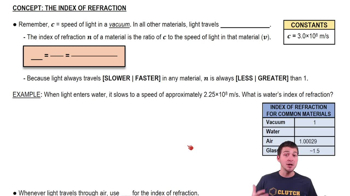
Refraction is the bending of light as it passes from one medium to another, which is quantified by the refractive index (n). The refractive index of a medium indicates how much the speed of light is reduced compared to its speed in a vacuum. In this problem, the mirror is immersed in water, affecting the effective focal length due to the change in light speed.
Recommended video:
Guided course
03:46
Index of Refraction

Lens Maker's Equation

The Lens Maker's Equation relates the focal length of a lens or mirror to the refractive indices of the media involved and the curvature of the surfaces. For a mirror in a different medium, the effective focal length can be adjusted using the formula f' = f/n, where f is the focal length in air and n is the refractive index of the surrounding medium. This concept is vital for calculating the new focal length of the concave mirror in water.
Recommended video:
05:38
Lens Maker Equation