
Ch 33: The Nature and Propagation of Light
Young & Freedman Calc - University Physics 15th Edition
Young & Freedman Calc15th EditionUniversity PhysicsISBN: 9780135159552Not the one you use?Change textbook
Chapter 32, Problem 15b

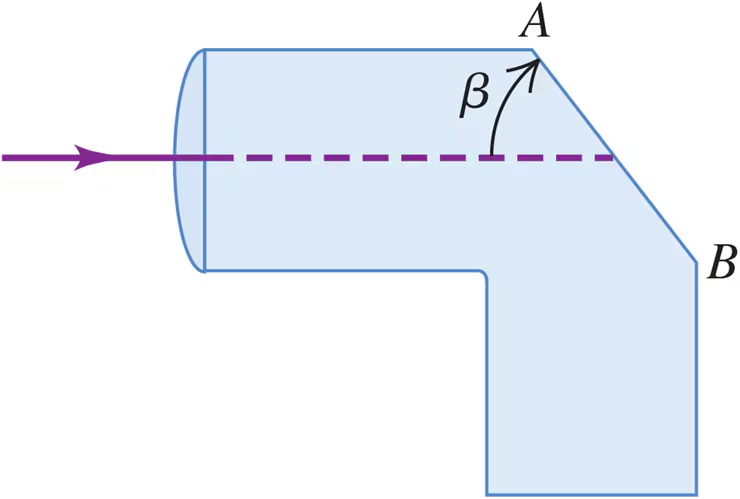
Light enters a solid pipe made of plastic having an index of refraction of 1.60. The light travels parallel to the upper part of the pipe (Fig. E33.15). You want to cut the face AB so that all the light will reflect back into the pipe after it first strikes that face. If the pipe is immersed in water of refractive index 1.33, what is the largest that u can be?

Verified step by step guidance
1
Identify the critical angle for total internal reflection at the interface between the plastic pipe and water. Use the formula for the critical angle: \( \theta_c = \sin^{-1} \left( \frac{n_2}{n_1} \right) \), where \( n_1 = 1.60 \) (refractive index of plastic) and \( n_2 = 1.33 \) (refractive index of water).
Calculate the critical angle \( \theta_c \) using the given refractive indices. This angle is the maximum angle of incidence at which light can strike the face AB and still be totally internally reflected.
Recognize that for total internal reflection to occur, the angle of incidence \( \theta_i \) must be greater than the critical angle \( \theta_c \). Therefore, the angle \( u \) in the problem must be such that the light strikes the face AB at an angle greater than \( \theta_c \).
Determine the relationship between the angle \( u \) and the angle of incidence \( \theta_i \) at the face AB. Since the light travels parallel to the upper part of the pipe, \( u \) is directly related to \( \theta_i \).
Conclude that the largest possible value of \( u \) is the angle that results in an angle of incidence equal to the critical angle. Therefore, \( u \) must be set such that the light strikes the face AB at exactly the critical angle for total internal reflection to occur.

Verified video answer for a similar problem:

This video solution was recommended by our tutors as helpful for the problem above.
Video duration:
5m
Was this helpful?

Key Concepts

Here are the essential concepts you must grasp in order to answer the question correctly.

Index of Refraction

The index of refraction, or refractive index, is a measure of how much light slows down as it passes through a medium. It is defined as the ratio of the speed of light in a vacuum to the speed of light in the medium. In this problem, the plastic pipe has an index of refraction of 1.60, and the surrounding water has an index of 1.33, affecting how light behaves at the interface.
Recommended video:
Guided course
03:46
Index of Refraction

Total Internal Reflection

Total internal reflection occurs when light traveling in a medium hits the boundary with a less dense medium at an angle greater than the critical angle, causing it to reflect entirely back into the original medium. This concept is crucial for ensuring that light reflects back into the pipe when it strikes face AB, as the angle of incidence must exceed the critical angle determined by the refractive indices of plastic and water.
Recommended video:
Guided course
05:29
Total Internal Reflection

Critical Angle

The critical angle is the minimum angle of incidence at which total internal reflection occurs. It is calculated using the formula: critical angle = arcsin(n2/n1), where n1 is the refractive index of the denser medium (plastic) and n2 is the refractive index of the less dense medium (water). Understanding this angle helps determine the maximum angle u for which light will reflect back into the pipe.
Recommended video:
Guided course
01:04
Critical Angle
Related Practice
Textbook Question

As shown in Fig. E33.11, a layer of water covers a slab of material X in a beaker. A ray of light traveling upward follows the path indicated. Using the information on the figure, find the angle the light makes with the normal in the air.

5
views
Textbook Question

A horizontal, parallel-sided plate of glass having a refractive index of 1.52 is in contact with the surface of water in a tank. A ray coming from above in air makes an angle of incidence of 35.0° with the normal to the top surface of the glass. What angle does the ray refracted into the water make with the normal to the surface?

3
views
Textbook Question

The indexes of refraction for violet light (λ = 400 nm) and red light (λ= 700 nm) in diamond are 2.46 and 2.41, respectively. A ray of light traveling through air strikes the diamond surface at an angle of 53.5° to the normal. Calculate the angular separation between these two colors of light in the refracted ray.

1
views
Textbook Question

Light enters a solid pipe made of plastic having an index of refraction of 1.60. The light travels parallel to the upper part of the pipe (Fig. E33.15). You want to cut the face AB so that all the light will reflect back into the pipe after it first strikes that face. What is the largest that u can be if the pipe is in air?

2
views
Textbook Question

The critical angle for total internal reflection at a liquid–air interface is 42.5°. If a ray of light traveling in the liquid has an angle of incidence at the interface of 35.0°, what angle does the refracted ray in the air make with the normal?

2
views
Textbook Question

At the very end of Wagner's series of operas Ring of the Nibelung, Brünnhilde takes the golden ring from the finger of the dead Siegfried and throws it into the Rhine, where it sinks to the bottom of the river. Assuming that the ring is small enough compared to the depth of the river to be treated as a point and that the Rhine is 10.0 m deep where the ring goes in, what is the area of the largest circle at the surface of the water over which light from the ring could escape from the water?

1
views