

A metal ring 4.50 cm in diameter is placed between the north and south poles of large magnets with the plane of its area perpendicular to the magnetic field. These magnets produce an initial uniform field of 1.12 T between them but are gradually pulled apart, causing this field to remain uniform but decrease steadily at 0.250 T/s. What is the magnitude of the electric field induced in the ring?
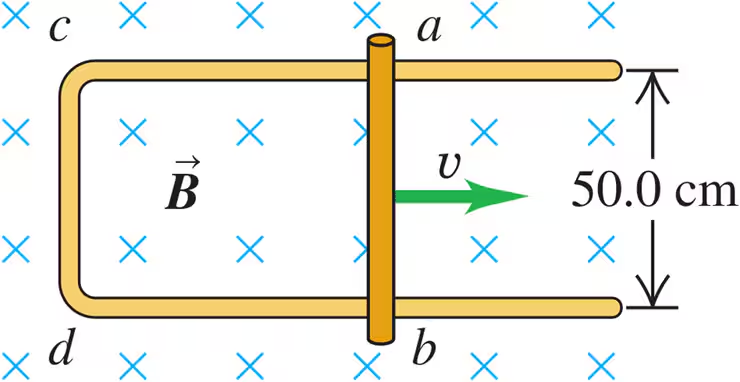
The conducting rod ab shown in Fig. E29.29 makes contact with metal rails ca and db. The apparatus is in a uniform magnetic field of 0.800 T, perpendicular to the plane of the figure. In what direction does the current flow in the rod?

Verified step by step guidance
Verified video answer for a similar problem:
Key Concepts
Faraday's Law of Electromagnetic Induction
Lorentz Force
Right-Hand Rule
Using Lenz's law, determine the direction of the current in resistor ab of Fig. E29.19 when (a) switch S is opened after having been closed for several minutes; (b) coil B is brought closer to coil A with the switch closed; (c) the resistance of R is decreased while the switch remains closed.
A long, thin solenoid has 400 turns per meter and radius 1.10 cm. The current in the solenoid is increasing at a uniform rate di/dt. The induced electric field at a point near the center of the solenoid and 3.50 cm from its axis is 8.00 × 10⁻⁶ V/m. Calculate di/dt.
A long, thin solenoid has 900 turns per meter and radius 2.50 cm. The current in the solenoid is increasing at a uniform rate of 36.0 A/s. What is the magnitude of the induced electric field at a point near the center of the solenoid and (a) 0.500 cm from the axis of the solenoid; (b) 1.00 cm from the axis of the solenoid?
A cardboard tube is wrapped with two windings of insulated wire wound in opposite directions, as shown in Fig. E29.20. Terminals a and b of winding A may be connected to a battery through a reversing switch. State whether the induced current in the resistor R is from left to right or from right to left in the following circumstances: (a) the current in winding Ais from a to b and is increasing; (b) the current in winding A is from b to a and is decreasing; (c) the current in winding A is from b to a and is increasing.
The current in Fig. obeys the equation , where . Find the direction (clockwise or counterclockwise) of the current induced in the round coil for .
