
Ch 29: Electromagnetic Induction
Young & Freedman Calc - University Physics 15th Edition
Young & Freedman Calc15th EditionUniversity PhysicsISBN: 9780135159552Not the one you use?Change textbook
Chapter 29, Problem 38b

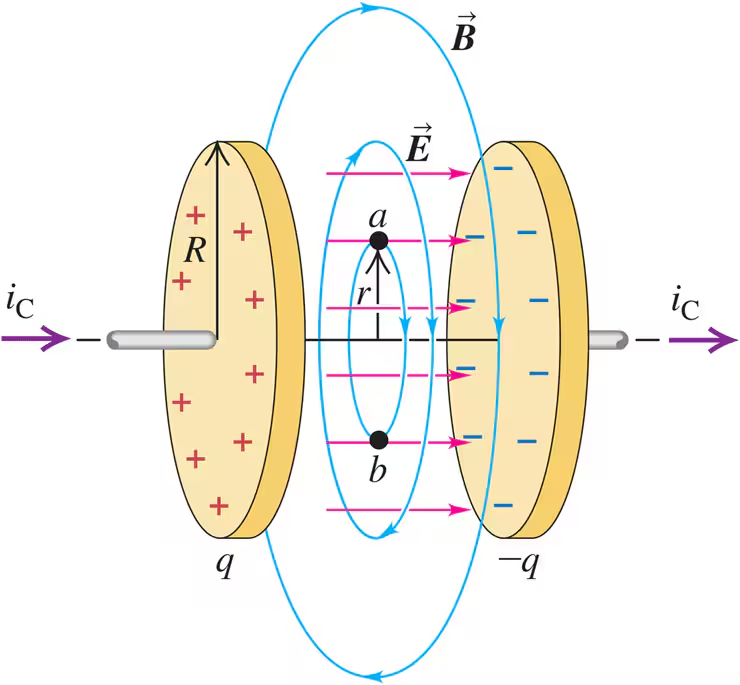
A parallel-plate, air-filled capacitor is being charged as in Fig. 29.23. The circular plates have radius 4.00 cm, and at a particular instant the conduction current in the wires is 0.520 A. What is the rate at which the electric field between the plates is changing?

Verified step by step guidance
1
First, understand that the conduction current in the wires is related to the displacement current between the plates of the capacitor. The displacement current is responsible for the changing electric field between the plates.
Recall the relationship between the displacement current \( I_d \) and the rate of change of the electric field \( \frac{dE}{dt} \) in a parallel-plate capacitor: \( I_d = \varepsilon_0 A \frac{dE}{dt} \), where \( \varepsilon_0 \) is the permittivity of free space and \( A \) is the area of the plates.
Calculate the area \( A \) of the circular plates using the formula \( A = \pi r^2 \), where \( r \) is the radius of the plates. Given \( r = 4.00 \) cm, convert this to meters for consistency in units.
Since the conduction current \( I_c \) is equal to the displacement current \( I_d \) in this scenario, set \( I_c = I_d \) and use the formula \( I_d = \varepsilon_0 A \frac{dE}{dt} \) to solve for \( \frac{dE}{dt} \). Rearrange the formula to \( \frac{dE}{dt} = \frac{I_c}{\varepsilon_0 A} \).
Substitute the known values into the equation: \( I_c = 0.520 \) A, \( \varepsilon_0 = 8.85 \times 10^{-12} \) C²/(N·m²), and the calculated area \( A \). This will give you the rate at which the electric field is changing between the plates.

Verified video answer for a similar problem:

This video solution was recommended by our tutors as helpful for the problem above.
Video duration:
5m
Was this helpful?

Key Concepts

Here are the essential concepts you must grasp in order to answer the question correctly.

Capacitor Basics

A capacitor is a device that stores electrical energy in an electric field, typically consisting of two conductive plates separated by an insulating material. The capacitance, which is the ability to store charge, depends on the area of the plates and the distance between them. Understanding how capacitors work is crucial for analyzing the electric field changes as they charge or discharge.
Recommended video:
Guided course
04:32
Phasors for Capacitors

Conduction Current

Conduction current refers to the flow of electric charge through a conductor, such as a wire, due to the movement of electrons. In the context of a charging capacitor, the conduction current is the rate at which charge is being transferred to the capacitor plates, influencing the electric field between them. It is measured in amperes (A) and is essential for determining the rate of change of the electric field.
Recommended video:

Changing Electric Field

The electric field between the plates of a capacitor changes as the capacitor charges or discharges. This change is related to the rate at which charge accumulates on the plates, which is directly linked to the conduction current. The rate of change of the electric field can be calculated using the relationship between current, charge, and electric field, providing insight into the dynamics of the capacitor's operation.
Recommended video:
Guided course
03:16
Intro to Electric Fields