


Ch 29: Electromagnetic Induction
Young & Freedman Calc - University Physics 15th Edition
Young & Freedman Calc15th EditionUniversity PhysicsISBN: 9780135159552Not the one you use?Change textbook
Chapter 29, Problem 14

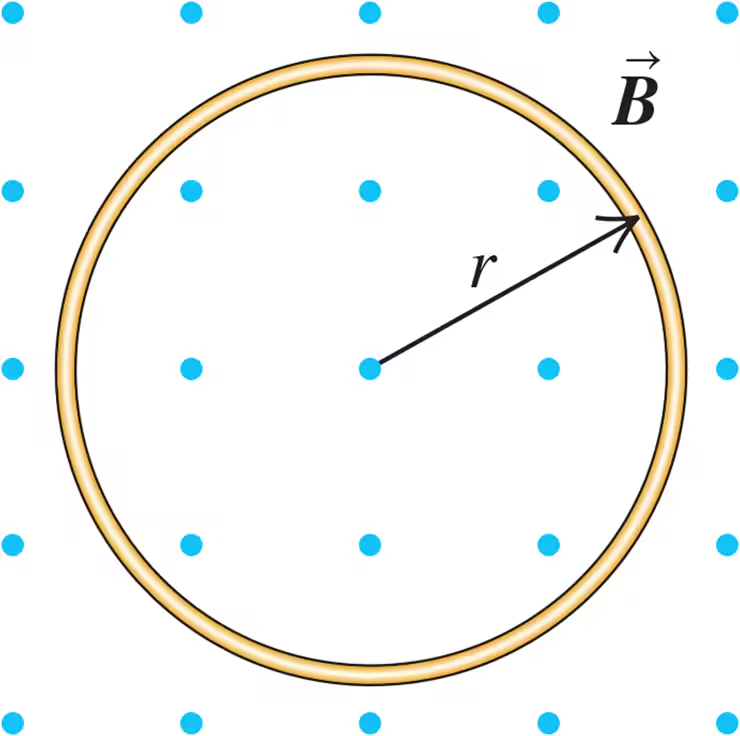
A circular loop of wire with radius r = 0.0480 m and resistance R = 0.160 Ω is in a region of spatially uniform magnetic field, as shown in Fig. E29.22. The magnetic field is directed out of the plane of the figure. The magnetic field has an initial value of 8.00 T and is decreasing at a rate of dB/dt = -0.680 T/s. Is the induced current in the loop clockwise or counterclockwise?

Verified step by step guidance
1
Identify the direction of the magnetic field: The crosses in the image indicate that the magnetic field is directed into the plane of the figure.
Apply Faraday's Law of Induction: The induced electromotive force (emf) in the loop is given by the rate of change of magnetic flux through the loop. The formula is \( \text{emf} = -\frac{d\Phi_B}{dt} \), where \( \Phi_B = B \cdot A \) is the magnetic flux.
Calculate the change in magnetic flux: Since the magnetic field is decreasing, \( \frac{dB}{dt} = -0.680 \text{ T/s} \). The area \( A \) of the loop is \( \pi r^2 \), where \( r = 0.0480 \text{ m} \).
Determine the direction of the induced current using Lenz's Law: Lenz's Law states that the direction of the induced current will be such that it opposes the change in magnetic flux. Since the magnetic field is decreasing, the induced current will create a magnetic field in the same direction as the original field (into the plane).
Conclude the direction of the induced current: To create a magnetic field into the plane, the induced current must flow in a clockwise direction when viewed from above the plane of the loop.

Verified video answer for a similar problem:

This video solution was recommended by our tutors as helpful for the problem above.
Video duration:
5m
Was this helpful?

Key Concepts

Here are the essential concepts you must grasp in order to answer the question correctly.

Faraday's Law of Induction

Faraday's Law states that a change in magnetic flux through a loop induces an electromotive force (EMF) in the wire. The induced EMF is proportional to the rate of change of the magnetic flux, which is the product of the magnetic field strength and the area of the loop. In this scenario, the decreasing magnetic field induces an EMF in the wire loop.
Recommended video:
Guided course
09:26
Faraday's Law

Lenz's Law

Lenz's Law explains the direction of the induced current in a loop. It states that the induced current will flow in a direction that opposes the change in magnetic flux. Since the magnetic field is decreasing, the induced current will create a magnetic field in the same direction as the original field to oppose the decrease, resulting in a counterclockwise current.
Recommended video:

Right-Hand Rule

The Right-Hand Rule is a mnemonic for determining the direction of the induced current. When the thumb points in the direction of the magnetic field, the fingers curl in the direction of the induced current. In this case, applying the rule shows that the induced current flows counterclockwise to maintain the magnetic field direction as it decreases.
Recommended video:
Guided course
19:11
Force on Moving Charges & Right Hand Rule
Related Practice
Textbook Question

Using Lenz's law, determine the direction of the current in resistor ab of Fig. E29.19 when (a) switch S is opened after having been closed for several minutes; (b) coil B is brought closer to coil A with the switch closed; (c) the resistance of R is decreased while the switch remains closed.

1
views
Textbook Question

A flat, rectangular coil of dimensions l and w is pulled with uniform speed v through a uniform magnetic field B with the plane of its area perpendicular to the field (Fig. E29.14). (a) Find the emf induced in this coil. (b) If the speed and magnetic field are both tripled, what is the induced emf?

Textbook Question

The armature of a small generator consists of a flat, square coil with 120 turns and sides with a length of 1.60 cm. The coil rotates in a magnetic field of 0.0750 T. What is the angular speed of the coil if the maximum emf produced is 24.0 mV?

2
views
Textbook Question

A circular loop of wire is in a region of spatially uniform magnetic field, as shown in Fig. E29.15. The magnetic field is directed into the plane of the figure. Determine the direction (clockwise or counterclockwise) of the induced current in the loop when (a) B is increasing; (b) B is decreasing; (c) B is constant with value B0. Explain your reasoning.

1
views
Textbook Question

A closely wound rectangular coil of 80 turns has dimen-sions of 25.0 cm by 40.0 cm. The plane of the coil is rotated from a position where it makes an angle of 37.0° with a magnetic field of 1.70 T to a position perpendicular to the field. The rotation takes 0.0600 s. What is the average emf induced in the coil?

Textbook Question

The current in Fig. E29.18E29.18 obeys the equation I(t)=I0ebtI(t)=I_0e^{-bt}, where b>0b > 0. Find the direction (clockwise or counterclockwise) of the current induced in the round coil for t>0t > 0.

1
views