Ch 28: Sources of Magnetic Field
Young & Freedman Calc - University Physics 15th Edition
Young & Freedman Calc15th EditionUniversity PhysicsISBN: 9780135159552Not the one you use?Change textbook
Chapter 28, Problem 42

A 15.0 cm long solenoid with radius 0.750 cm is closely wound with 600 turns of wire. The current in the windings is 8.00 A. Compute the magnetic field at a point near the center of the solenoid.

Verified step by step guidance
1
Understand the formula for the magnetic field inside a solenoid: The magnetic field inside a solenoid is given by the formula: B=μnI, where B is the magnetic field, μ is the permeability of free space (μ=4π×107Tm/A), n is the number of turns per unit length, and I is the current.
Calculate the number of turns per unit length: The solenoid has 600 turns and a length of 15.0 cm. Convert the length to meters: 15.0/100=0.15 meters. Then, calculate n as n=600/0.15 turns per meter.
Substitute the values into the formula: Use the values μ=4π×107, n from the previous step, and I=8.00 A into the formula B=μnI.
Perform the multiplication: Multiply the values of μ, n, and I to find the magnetic field B.
Interpret the result: The calculated magnetic field B represents the strength of the magnetic field at a point near the center of the solenoid, which is uniform and parallel to the axis of the solenoid.

Verified video answer for a similar problem:

This video solution was recommended by our tutors as helpful for the problem above.
Video duration:
1m
Was this helpful?

Key Concepts

Here are the essential concepts you must grasp in order to answer the question correctly.

Magnetic Field of a Solenoid

The magnetic field inside a long solenoid is uniform and parallel to the axis of the solenoid. It is given by the formula B = μ₀ * n * I, where B is the magnetic field, μ₀ is the permeability of free space, n is the number of turns per unit length, and I is the current. This formula assumes the solenoid is infinitely long, but it provides a good approximation near the center of a finite solenoid.
Recommended video:
Guided course
13:54
Magnetic Field Produced by Loops and Solenoids

Permeability of Free Space

The permeability of free space, denoted as μ₀, is a fundamental physical constant that describes the ability of a vacuum to support the formation of a magnetic field. Its value is approximately 4π × 10⁻⁷ T·m/A. This constant is crucial in calculating the magnetic field in various electromagnetic contexts, including solenoids.
Recommended video:
Guided course
5:05
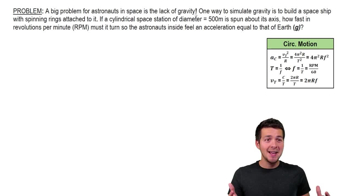
Spinning Space Station

Turns per Unit Length

Turns per unit length, denoted as n, is a measure of how many loops of wire are wound per unit length of the solenoid. It is calculated by dividing the total number of turns by the length of the solenoid. This parameter is essential in determining the strength of the magnetic field inside the solenoid, as it directly influences the field's magnitude according to the formula B = μ₀ * n * I.
Recommended video:
Guided course
10:54
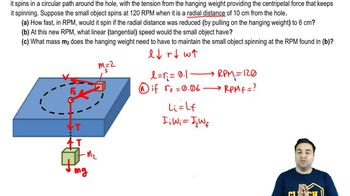
Spinning on a string of variable length
Related Practice
Textbook Question

A solenoid is designed to produce a magnetic field of 0.0270 T at its center. It has radius 1.40 cm and length 40.0 cm, and the wire can carry a maximum current of 12.0 A. What total length of wire is required?

3
views

Textbook Question

A closed curve encircles several conductors. The line integral Bdl\(\oint\) B\(\cdot\) dl around this curve is 3.83×10⁴ T m3.83\(\times\)10^{-4}\(\text{ T m}\). If you were to integrate around the curve in the opposite direction, what would be the value of the line integral? Explain.

1
views
Textbook Question

As a new electrical technician, you are designing a large solenoid to produce a uniform 0.150 T magnetic field near the center of the solenoid. You have enough wire for 4000 circular turns. This solenoid must be 55.0 cm long and 2.80 cm in diameter. What current will you need to produce the necessary field?

1
views
Textbook Question

A solid conductor with radius a is supported by insulating disks on the axis of a conducting tube with inner radius b and outer radius c (Fig. E28.43). The central conductor and tube carry equal currents I in opposite directions. The currents are distributed uniformly over the cross sections of each conductor. Derive an expression for the magnitude of the magnetic field at points outside the tube (r > c).

1
views
Textbook Question

A solenoid is designed to produce a magnetic field of 0.0270 T at its center. It has radius 1.40 cm and length 40.0 cm, and the wire can carry a maximum current of 12.0 A. What minimum number of turns per unit length must the solenoid have?

14
views