Ch 27: Magnetic Field and Magnetic Forces
Young & Freedman Calc - University Physics 15th Edition
Young & Freedman Calc15th EditionUniversity PhysicsISBN: 9780135159552Not the one you use?Change textbook
Chapter 27, Problem 17

A 150 g ball containing 4.00 x 10⁸ excess electrons is dropped into a 125 m vertical shaft. At the bottom of the shaft, the ball suddenly enters a uniform horizontal magnetic field that has magnitude 0.250 T and direction from east to west. If air resistance is negligibly small, find the magnitude and direction of the force that this magnetic field exerts on the ball just as it enters the field.

Verified step by step guidance
1
First, calculate the charge of the ball using the number of excess electrons. The charge of one electron is approximately \(-1.6 \times 10^{-19}\) C. Multiply this by the number of excess electrons \(4.00 \times 10^8\) to find the total charge \(q\) on the ball.
Next, identify the velocity of the ball as it enters the magnetic field. Since the ball is dropped from a height of 125 m, use the kinematic equation \(v^2 = u^2 + 2gh\) where \(u = 0\) (initial velocity), \(g = 9.8\) m/s² (acceleration due to gravity), and \(h = 125\) m (height) to find the final velocity \(v\).
Now, apply the formula for the magnetic force \(F = qvB\sin\theta\), where \(q\) is the charge calculated in step 1, \(v\) is the velocity from step 2, \(B = 0.250\) T is the magnetic field strength, and \(\theta\) is the angle between the velocity and the magnetic field direction. Since the ball enters the field horizontally, \(\theta = 90^\circ\), making \(\sin\theta = 1\).
Calculate the magnitude of the force using the values obtained: \(F = qvB\). Substitute the values of \(q\), \(v\), and \(B\) into the equation to find the force.
Determine the direction of the force using the right-hand rule. Point your fingers in the direction of the velocity (downward), curl them towards the direction of the magnetic field (east to west), and your thumb will point in the direction of the force. This will help you identify the direction of the force exerted on the ball.

Verified video answer for a similar problem:

This video solution was recommended by our tutors as helpful for the problem above.
Video duration:
7m
Was this helpful?

Key Concepts

Here are the essential concepts you must grasp in order to answer the question correctly.

Magnetic Force on a Moving Charge

The magnetic force on a moving charge is given by the Lorentz force equation, F = q(v × B), where q is the charge, v is the velocity, and B is the magnetic field. This force is perpendicular to both the velocity of the charge and the magnetic field direction, influencing the trajectory of charged particles in a magnetic field.
Recommended video:
Guided course
09:08
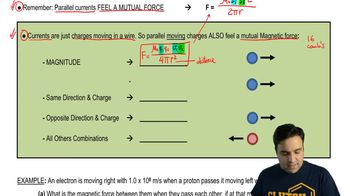
Magnetic Force Between Two Moving Charges

Charge Calculation from Excess Electrons

The charge of an object can be calculated from the number of excess electrons using the formula q = n × e, where n is the number of excess electrons and e is the elementary charge (approximately 1.6 × 10^-19 C). This calculation is crucial for determining the force exerted by the magnetic field on the charged ball.
Recommended video:
Guided course
04:43
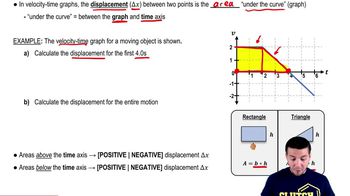
Calculating Displacement from Velocity-Time Graphs

Gravitational Acceleration

Gravitational acceleration, denoted as g, is the acceleration of an object due to Earth's gravity, approximately 9.81 m/s². When the ball is dropped, it accelerates downwards due to gravity, and its velocity upon entering the magnetic field can be calculated using kinematic equations, which is essential for determining the magnetic force.
Recommended video:
Guided course
07:32
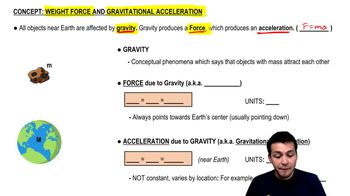
Weight Force & Gravitational Acceleration
Related Practice
Textbook Question

A flat, square surface with side length 3.40cm3.40\(\operatorname{cm}\) is in the xy-plane at z=0z = 0. Calculate the magnitude of the flux through this surface produced by a magnetic field B=(0.200T)i+(0.300T)j(0.500T)kB=(0.200T)\(\mathbf{i}\)+(0.300T)\(\mathbf{j}\)-(0.500T)\(\mathbf{k}\).

1
views
Textbook Question

Cyclotrons are widely used in nuclear medicine for producing short-lived radioactive isotopes. These cyclotrons typically accelerate H- (the hydride ion, which has one proton and two electrons) to an energy of 5 MeV to 20 MeV. This ion has a mass very close to that of a proton because the electron mass is negligible — about 1/2000 of the proton's mass. A typical magnetic field in such cyclotrons is 1.9 T. (a) What is the speed of a 5.0 MeV H-? (b) If the H- has energy 5.0 MeV and B = 1.9 T, what is the radius of this ion's circular orbit?

1
views
Textbook Question

An open plastic soda bottle with an opening diameter of 2.5 cm is placed on a table. A uniform 1.75 T magnetic field directed upward and oriented 25° from vertical encompasses the bottle. What is the total magnetic flux through the plastic of the soda bottle?

12
views
Textbook Question

A beam of protons traveling at 1.20 km/s enters a uniform magnetic field, traveling perpendicular to the field. The beam exits the magnetic field, leaving the field in a direction perpendicular to its original direction (Fig. E27.24) . The beam travels a distance of 1.18 cm while in the field. What is the magnitude of the magnetic field?

1
views
Textbook Question

A horizontal rectangular surface has dimensions 2.80 cm by 3.20 cm and is in a uniform magnetic field that is directed at an angle of 30.0° above the horizontal. What must the magnitude of the magnetic field be to produce a flux of 3.10 x 10⁻⁴ Wb through the surface?

Textbook Question

A deuteron (the nucleus of an isotope of hydrogen) has a mass of 3.34 x 10⁻²⁷ kg and a charge of +e. The deuteron travels in a circular path with a radius of 6.96 mm in a magnetic field with magnitude 2.50 T. (a) Find the speed of the deuteron. (b) Find the time required for it to make half a revolution. (c) Through what potential difference would the deuteron have to be accelerated to acquire this speed?

1
views