Ch 23: Electric Potential
Young & Freedman Calc - University Physics 15th Edition
Young & Freedman Calc15th EditionUniversity PhysicsISBN: 9780135159552Not the one you use?Change textbook
Chapter 23, Problem 22a

At a certain distance from a point charge, the potential and electric-field magnitude due to that charge are 4.984.98 V and 16.216.2 V/m, respectively. (Take V=0V = 0 at infinity.) What is the distance to the point charge?

Verified step by step guidance
1
Start by recalling the relationship between electric potential (V) and electric field (E) for a point charge. The electric potential at a distance r from a point charge Q is given by the formula: V=kQr, where k is Coulomb's constant (approximately 8.99 × 10^9 N m²/C²).
The electric field magnitude at the same distance r from the point charge is given by: E=kQr2.
You have two equations: V=kQr and E=kQr2. You can solve these simultaneously to find the distance r. First, express Q in terms of V and r from the first equation: Q=Vrk.
Substitute the expression for Q into the equation for E: E=kVrkr2. Simplify this to get: E=Vr.
Rearrange the equation E=Vr to solve for r: r=VE. Substitute the given values for V and E to find the distance r.

Verified video answer for a similar problem:

This video solution was recommended by our tutors as helpful for the problem above.
Video duration:
5m
Was this helpful?

Key Concepts

Here are the essential concepts you must grasp in order to answer the question correctly.

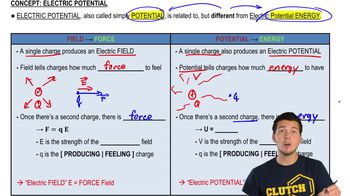
Electric Potential

Electric potential (V) at a point in space is the work done per unit charge in bringing a positive test charge from infinity to that point. It is a scalar quantity and is measured in volts (V). For a point charge, the potential is given by V = kQ/r, where k is Coulomb's constant, Q is the charge, and r is the distance from the charge.
Recommended video:
Guided course
07:33
Electric Potential

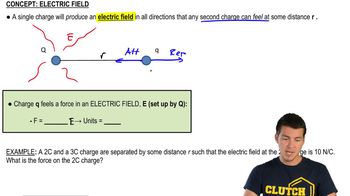
Electric Field

The electric field (E) is a vector field around a charged object where a force would be exerted on other charges. It is defined as the force per unit charge and is measured in volts per meter (V/m). For a point charge, the electric field is given by E = kQ/r², indicating how the field strength decreases with the square of the distance from the charge.
Recommended video:
Guided course
03:16
Intro to Electric Fields

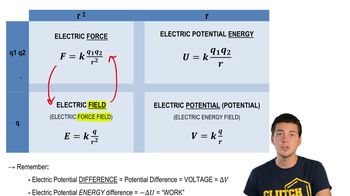
Relationship Between Electric Field and Potential

The electric field is related to the electric potential by the gradient, where E = -dV/dr for a radial field. This relationship shows that the electric field is the rate of change of the potential with respect to distance. For a point charge, this can be used to derive the distance from the charge when both the potential and field magnitude are known.
Recommended video:
Guided course
03:43
Relationships Between Force, Field, Energy, Potential
Related Practice
Textbook Question

Two point charges q1=+2.40q_1 = +2.40 nC and q2=6.50q_2 = -6.50 nC are 0.1000.100 m apart. Point AA is midway between them; point BB is 0.0800.080 m from q1q_1 and 0.0600.060 m from q2q_2 (Fig. E23.1923.19). Take the electric potential to be zero at infinity. Find the potential at point BB.

1
views
Textbook Question

An electron is to be accelerated from 3.00×1063.00\(\times\)10^6 m/s to 8.00×1068.00\(\times\)10^6 m/s. Through what potential difference must the electron pass to accomplish this?

Textbook Question

A thin spherical shell with radius R1=3.00R_1 = 3.00 cm is concentric with a larger thin spherical shell with radius R2=5.00R_2 = 5.00 cm. Both shells are made of insulating material. The smaller shell has charge q1=+6.00q_1 = +6.00 nC distributed uniformly over its surface, and the larger shell has charge q2=9.00q_2 = -9.00 nC distributed uniformly over its surface. Take the electric potential to be zero at an infinite distance from both shells. What is the electric potential due to the two shells at the following distance from their common center: (i) r=0 r=0; (ii) r=4.00r=4.00 cm; (iii) r=6.00r=6.00 cm?

1
views
Textbook Question

Two point charges q1=+2.40q_1 = +2.40 nC and q2=6.50q_2 = -6.50 nC are 0.1000.100 m apart. Point AA is midway between them; point BB is 0.0800.080 m from q1q_1 and 0.0600.060 m from q2q_2 (Fig. E23.1923.19). Take the electric potential to be zero at infinity. Find the potential at point AA.

1
views
Textbook Question

At a certain distance from a point charge, the potential and electric-field magnitude due to that charge are 4.984.98 V and 16.216.2 V/m, respectively. (Take V=0V = 0 at infinity.) What is the magnitude of the charge?

2
views
Textbook Question

At a certain distance from a point charge, the potential and electric-field magnitude due to that charge are 4.984.98 V and 16.216.2 V/m, respectively. (Take V=0V = 0 at infinity.) Is the electric field directed toward or away from the point charge?