
Textbook Question
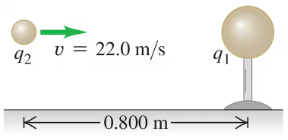
Two protons, starting several meters apart, are aimed directly at each other with speeds of m/s, measured relative to the earth. Find the maximum electric force that these protons will exert on each other.

 Verified step by step guidance
 09:52
09:52
 06:24
06:24 07:51
07:51Two protons, starting several meters apart, are aimed directly at each other with speeds of m/s, measured relative to the earth. Find the maximum electric force that these protons will exert on each other.
Two protons are released from rest when they are nm apart. What is the maximum acceleration they will achieve and when does this acceleration occur?
A small particle has charge C and mass kg. It moves from point , where the electric potential is V, to point , where the electric potential is V. The electric force is the only force acting on the particle. The particle has speed m/s at point . What is its speed at point ? Is it moving faster or slower at than at ? Explain.
How much work would it take to push two protons very slowly from a separation of m (a typical atomic distance) to m (a typical nuclear distance)? If the protons are both released from rest at the closer distance in part (a), how fast are they moving when they reach their original separation?
A point charge C is held stationary at the origin. A second point charge C moves from the point m, to the point m, m. How much work is done by the electric force on ?