
Ch 22: Gauss' Law
Young & Freedman Calc - University Physics 15th Edition
Young & Freedman Calc15th EditionUniversity PhysicsISBN: 9780135159552Not the one you use?Change textbook
Chapter 22, Problem 19b

A hollow, conducting sphere with an outer radius of 0.2500.250 m and an inner radius of 0.2000.200 m has a uniform surface charge density of +6.37×10⁶+6.37\(\times\)10^{-6} C/m2. A charge of 0.500−0.500 μ\(\mu\)C is now introduced at the center of the cavity inside the sphere. Calculate the strength of the electric field just outside the sphere?

Verified step by step guidance
1
First, understand that the electric field just outside a conducting sphere is determined by the total charge enclosed within the sphere. The charge on the sphere itself and any charge inside the cavity contribute to this total charge.
Calculate the total charge on the surface of the sphere using the formula for surface charge density: \( Q_{surface} = \sigma \times A \), where \( \sigma = 6.37 \times 10^{-6} \) C/m² is the surface charge density and \( A = 4\pi r_{outer}^2 \) is the surface area of the sphere with \( r_{outer} = 0.250 \) m.
Add the charge introduced at the center of the cavity to the charge on the surface to find the total charge enclosed by the sphere. The charge introduced is \( -0.500 \mu C \) or \( -0.500 \times 10^{-6} \) C.
Use Gauss's Law to find the electric field just outside the sphere. Gauss's Law states that \( \Phi = \frac{Q_{enclosed}}{\varepsilon_0} \), where \( \Phi \) is the electric flux and \( \varepsilon_0 \) is the permittivity of free space (\( 8.85 \times 10^{-12} \) C²/N·m²). The electric field \( E \) is related to the flux by \( \Phi = E \times A \), where \( A \) is the area of the Gaussian surface.
Solve for the electric field \( E \) using the equation \( E = \frac{Q_{enclosed}}{\varepsilon_0 \times A} \), where \( A = 4\pi r_{outer}^2 \). This will give you the strength of the electric field just outside the sphere.

Verified video answer for a similar problem:

This video solution was recommended by our tutors as helpful for the problem above.
Video duration:
5m
Was this helpful?

Key Concepts

Here are the essential concepts you must grasp in order to answer the question correctly.

Gauss's Law

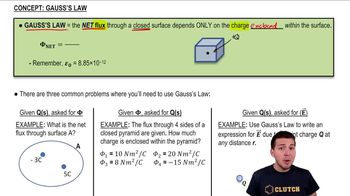
Gauss's Law relates the electric flux through a closed surface to the charge enclosed by that surface. It is essential for calculating electric fields in symmetric charge distributions, such as spherical conductors. The law states that the total electric flux is equal to the enclosed charge divided by the permittivity of free space.
Recommended video:

Conductors in Electrostatic Equilibrium

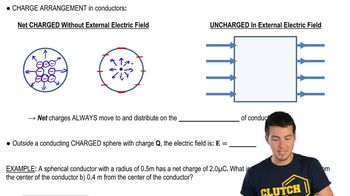
In electrostatic equilibrium, conductors have no electric field inside them, and any excess charge resides on the surface. This principle helps determine the distribution of charge on the sphere and the resulting electric field outside it. The surface charge density affects the field strength just outside the conductor.
Recommended video:
Guided course
07:43
Electric Fields in Conductors

Superposition Principle

The superposition principle states that the total electric field due to multiple charges is the vector sum of the fields due to each charge individually. This concept is crucial for calculating the net electric field outside the sphere, considering both the surface charge and the introduced charge at the center.
Recommended video:
Guided course
03:32
Superposition of Sinusoidal Wave Functions
Related Practice
Textbook Question

Charge qq is distributed uniformly throughout the volume of an insulating sphere of radius R=4.00R = 4.00 cm. At a distance of r=8.00r = 8.00 cm from the center of the sphere, the electric field due to the charge distribution has magnitude E=940E = 940 N/C. What is the volume charge density for the sphere?

Textbook Question

A hollow, conducting sphere with an outer radius of 0.2500.250 m and an inner radius of 0.2000.200 m has a uniform surface charge density of +6.37×10⁶+6.37\(\times\)10^{-6} C/m2. A charge of 0.500−0.500 μ\(\mu\)C is now introduced at the center of the cavity inside the sphere. What is the electric flux through a spherical surface just inside the inner surface of the sphere?

Textbook Question

A hollow, conducting sphere with an outer radius of 0.2500.250 m and an inner radius of 0.2000.200 m has a uniform surface charge density of +6.37×10⁶+6.37\(\times\)10^{-6} C/m2. A charge of 0.500−0.500 μ\(\mu\)C is now introduced at the center of the cavity inside the sphere. What is the new charge density on the outside of the sphere?

Textbook Question

Charge qq is distributed uniformly throughout the volume of an insulating sphere of radius R=4.00R = 4.00 cm. At a distance of r=8.00r = 8.00 cm from the center of the sphere, the electric field due to the charge distribution has magnitude E=940E = 940 N/C. What is the electric field at a distance of 2.002.00 cm from the sphere's center?

Textbook Question

A very long uniform line of charge has charge per unit length 4.804.80 μ\(\mu\)C/m and lies along the xx-axis. A second long uniform line of charge has charge per unit length 2.40-2.40 μ\(\mu\)C/m and is parallel to the xx-axis at y=0.400y = 0.400 m. What is the net electric field (magnitude and direction) at the following points on the yy-axis: (a) y=0.200y = 0.200 m and (b) y=0.600 y = 0.600 m?

1
views
Textbook Question

Some planetary scientists have suggested that the planet Mars has an electric field somewhat similar to that of the earth, producing a net electric flux of 3.63×10¹⁶-3.63\(\times\)10^{16} Nm2/C at the planet's surface. Calculate the charge density on Mars, assuming all the charge is uniformly distributed over the planet's surface.

1
views