Ch 21: Electric Charge and Electric Field
Young & Freedman Calc - University Physics 15th Edition
Young & Freedman Calc15th EditionUniversity PhysicsISBN: 9780135159552Not the one you use?Change textbook
Chapter 21, Problem 3

If a proton and an electron are released when they are 2.0×10102.0\(\times\)10^{-10} m apart (a typical atomic distance), find the initial acceleration of each particle.

Verified step by step guidance
1
Start by identifying the forces acting on the proton and electron. The primary force here is the electrostatic force due to their charges. Use Coulomb's Law to calculate this force: F=kqqr2, where k is Coulomb's constant, q is the charge of the proton or electron, and r is the distance between them.
Calculate the electrostatic force using the known values: k = 8.99 × 10⁹ N m2/C2, q = 1.6 × 10⁻¹⁹ C, and r = 2.0 × 10⁻¹⁰ m.
Once the force is calculated, use Newton's second law to find the acceleration of each particle. Newton's second law states: F=ma, where m is the mass of the particle and a is the acceleration.
Calculate the acceleration of the proton using its mass: m = 1.67 × 10⁻²⁷ kg. Rearrange Newton's second law to solve for acceleration: a=Fm.
Similarly, calculate the acceleration of the electron using its mass: m = 9.11 × 10⁻³¹ kg. Use the same rearranged formula: a=Fm.

Verified video answer for a similar problem:

This video solution was recommended by our tutors as helpful for the problem above.
Video duration:
5m
Was this helpful?

Key Concepts

Here are the essential concepts you must grasp in order to answer the question correctly.

Coulomb's Law

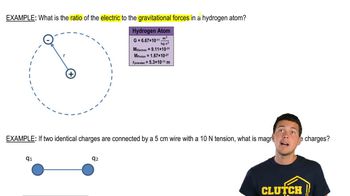
Coulomb's Law describes the electrostatic force between two charged particles. It states that the force is directly proportional to the product of the charges and inversely proportional to the square of the distance between them. This law is essential for calculating the force acting on the proton and electron due to their charges.
Recommended video:
Guided course
09:52
Coulomb's Law

Newton's Second Law of Motion

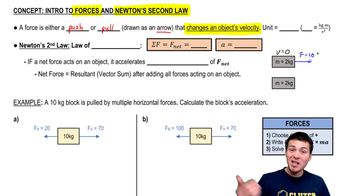
Newton's Second Law states that the acceleration of an object is directly proportional to the net force acting on it and inversely proportional to its mass (F = ma). This principle is crucial for determining the initial acceleration of the proton and electron once the electrostatic force is known.
Recommended video:
Guided course
06:54
Intro to Forces & Newton's Second Law

Mass of Proton and Electron

Understanding the mass of the proton and electron is vital for calculating their acceleration. The proton has a mass of approximately 1.67 x 10^-27 kg, while the electron's mass is about 9.11 x 10^-31 kg. These values are necessary to apply Newton's Second Law and find the acceleration of each particle.
Recommended video:
Guided course
20:32
Mass Spectrometers