Ch 21: Electric Charge and Electric Field
Young & Freedman Calc - University Physics 15th Edition
Young & Freedman Calc15th EditionUniversity PhysicsISBN: 9780135159552Not the one you use?Change textbook
Chapter 21, Problem 20b

A uniform electric field exists in the region between two oppositely charged plane parallel plates. A proton is released from rest at the surface of the positively charged plate and strikes the surface of the opposite plate, 1.601.60 cm distant from the first, in a time interval of 3.20×1063.20\(\times\)10^{-6} s. Find the speed of the proton when it strikes the negatively charged plate.

Verified step by step guidance
1
Start by understanding the motion of the proton. It is released from rest, meaning its initial velocity is zero. The proton is accelerated by the uniform electric field between the plates.
Use the kinematic equation for uniformly accelerated motion: v=u+at, where v is the final velocity, u is the initial velocity (0 in this case), a is the acceleration, and t is the time interval.
To find the acceleration, use the equation a=Fm, where F is the force on the proton due to the electric field and m is the mass of the proton. The force can be calculated using F=qE, where q is the charge of the proton and E is the electric field strength.
The electric field strength can be determined from the potential difference between the plates and the distance between them using E=Vd, where V is the potential difference and d is the distance between the plates.
Substitute the values for acceleration and time into the kinematic equation to find the final speed of the proton when it strikes the negatively charged plate.

Verified video answer for a similar problem:

This video solution was recommended by our tutors as helpful for the problem above.
Video duration:
5m
Was this helpful?

Key Concepts

Here are the essential concepts you must grasp in order to answer the question correctly.

Uniform Electric Field

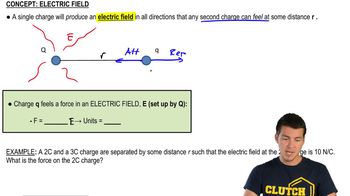
A uniform electric field is a region where the electric field strength is constant in magnitude and direction. In this scenario, the field exists between two parallel plates with opposite charges, causing a constant force on charged particles like protons, which accelerates them uniformly across the field.
Recommended video:
Guided course
03:16
Intro to Electric Fields

Kinematics in Physics

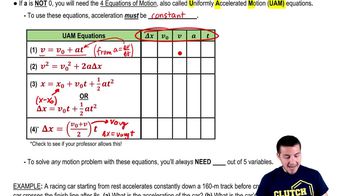
Kinematics involves the study of motion without considering the forces that cause it. To find the speed of the proton, we use kinematic equations that relate displacement, time, initial velocity, and acceleration, assuming constant acceleration due to the uniform electric field.
Recommended video:
Guided course
08:25
Kinematics Equations

Electric Force on a Proton

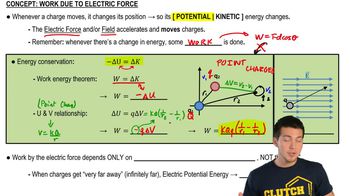
The electric force acting on a proton in an electric field is given by F = qE, where q is the charge of the proton and E is the electric field strength. This force causes the proton to accelerate, and understanding this relationship is crucial for calculating the proton's final speed as it moves between the plates.
Recommended video:
Guided course
14:21
Work due to Electric Force
Related Practice
Textbook Question

Three point charges are arranged along the xx-axis. Charge q1=+3.00q_1=+3.00 μ\(\mu\)C is at the origin, and charge q2=5.00q_2=-5.00 μ\(\mu\)C is at x=0.200x = 0.200 m. Charge q2=8.00q_2=-8.00 μ\(\mu\)C. Where is q3q_3 located if the net force on q1q_1 is 7.007.00 N in the x-x-direction?

1
views
Textbook Question

A uniform electric field exists in the region between two oppositely charged plane parallel plates. A proton is released from rest at the surface of the positively charged plate and strikes the surface of the opposite plate, 1.601.60 cm distant from the first, in a time interval of 3.20×1063.20\(\times\)10^{-6} s. Find the magnitude of the electric field.

1
views
Textbook Question

A proton is traveling horizontally to the right at 4.50×1064.50\(\times\)10^6 m/s. How much time does it take the proton to stop after entering the field?

Textbook Question

Three point charges are arranged on a line. Charge q3=+5.00q_3=+5.00 nC and is at the origin. Charge q2=3.00q_2=-3.00 nC and is at x=+4.00x = +4.00 cm. Charge q1q_1 is at x=+2.00x = +2.00 cm. What is q1q_1 (magnitude and sign) if the net force on q3q_3 is zero?

Textbook Question

A proton is traveling horizontally to the right at 4.50×1064.50\(\times\)10^6 m/s. Find the magnitude and direction of the weakest electric field that can bring the proton uniformly to rest over a distance of 3.203.20 cm.

3
views
Textbook Question

A proton is traveling horizontally to the right at 4.50×1064.50\(\times\)10^6 m/s. What minimum field (magnitude and direction) would be needed to stop an electron under the conditions of part (a)? Note: Part (a) asks for how much time does it take the proton to stop after entering the field.

1
views