A diesel engine performs J of mechanical work and discards J of heat each cycle. How much heat must be supplied to the engine in each cycle?
Ch 20: The Second Law of Thermodynamics
Young & Freedman Calc15th EditionUniversity PhysicsISBN: 9780135159552Not the one you use?Change textbook
Chapter 20, Problem 8a
Calculate the theoretical efficiency for an Otto-cycle engine with and .
Verified step by step guidance1
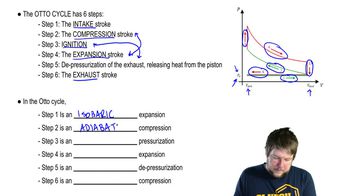
Understand the Otto cycle: The Otto cycle is a thermodynamic cycle that describes the functioning of a typical spark ignition piston engine. It consists of two isochoric processes (constant volume) and two adiabatic processes (no heat exchange).
Identify the formula for the efficiency of an Otto cycle engine: The efficiency \( \eta \) of an Otto cycle engine is given by the formula \( \eta = 1 - \frac{1}{r^{\gamma - 1}} \), where \( r \) is the compression ratio and \( \gamma \) is the specific heat ratio.
Substitute the given values into the formula: You are given \( \gamma = 1.40 \) and \( r = 9.50 \). Substitute these values into the efficiency formula: \( \eta = 1 - \frac{1}{9.50^{1.40 - 1}} \).
Simplify the expression: Calculate \( 1.40 - 1 \) to get \( 0.40 \). Then, compute \( 9.50^{0.40} \) to find the value of the denominator.
Calculate the efficiency: Subtract the result from 1 to find the theoretical efficiency of the Otto-cycle engine.

Verified video answer for a similar problem:
This video solution was recommended by our tutors as helpful for the problem above.
Video duration:
1mWas this helpful?
Key Concepts
Here are the essential concepts you must grasp in order to answer the question correctly.
Otto Cycle
The Otto cycle is a thermodynamic cycle that describes the functioning of a typical spark-ignition piston engine. It consists of two adiabatic and two isochoric processes. Understanding the Otto cycle is crucial for calculating the efficiency of engines that operate on this cycle, such as gasoline engines.
Recommended video:
Guided course
The Otto Cycle
Specific Heat Ratio (γ)
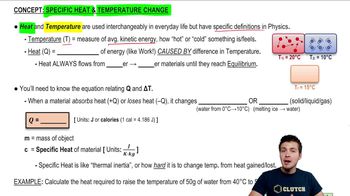
The specific heat ratio, denoted as γ (gamma), is the ratio of the specific heat at constant pressure (Cp) to the specific heat at constant volume (Cv). It is a critical parameter in thermodynamics, affecting the efficiency of cycles like the Otto cycle. For air, γ is typically around 1.40, which influences the theoretical efficiency calculation.
Recommended video:
Guided course
Specific Heat & Temperature Changes
Compression Ratio (r)
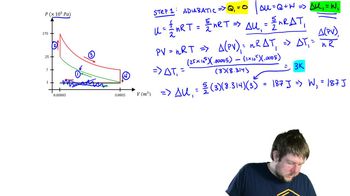
The compression ratio, denoted as r, is the ratio of the maximum to minimum volume in the cylinder of an internal combustion engine. It is a key factor in determining the efficiency of the Otto cycle, as higher compression ratios generally lead to higher efficiencies. In this question, r is given as 9.50, which is used in the efficiency formula.
Recommended video:
Guided course
Finding the Compression Ratio
Related Practice
Textbook Question
2
views
Textbook Question
A Carnot engine is operated between two heat reservoirs at temperatures of K and K. If the engine receives kJ of heat energy from the reservoir at K in each cycle, how many joules per cycle does it discard to the reservoir at K?
2
views
Textbook Question
A refrigerator has a coefficient of performance of , runs on an input of W of electrical power, and keeps its inside compartment at °C. If you put a dozen -L plastic bottles of water at °C into this refrigerator, how long will it take for them to be cooled down to °C? (Ignore any heat that leaves the plastic.)
2
views
Textbook Question
The Otto-cycle engine in a Mercedes-Benz SLK230 has a compression ratio of . What is the ideal efficiency of the engine? Use .
1
views