Ch 19: The First Law of Thermodynamics
Young & Freedman Calc - University Physics 15th Edition
Young & Freedman Calc15th EditionUniversity PhysicsISBN: 9780135159552Not the one you use?Change textbook
Chapter 19, Problem 27a

A monatomic ideal gas that is initially at 1.50×1051.50\(\times\)10^5 Pa and has a volume of 0.08000.0800 m3 is compressed adiabatically to a volume of 0.04000.0400 m3. What is the final pressure?

Verified step by step guidance
1
Understand that the process is adiabatic, meaning no heat is exchanged with the surroundings. For an adiabatic process involving an ideal gas, the relation between pressure and volume is given by the equation: \( P_1 V_1^\gamma = P_2 V_2^\gamma \), where \( \gamma \) is the adiabatic index (ratio of specific heats, \( C_p/C_v \)). For a monatomic ideal gas, \( \gamma = \frac{5}{3} \).
Identify the known values: initial pressure \( P_1 = 1.50 \times 10^5 \) Pa, initial volume \( V_1 = 0.0800 \) m\(^3\), and final volume \( V_2 = 0.0400 \) m\(^3\). The final pressure \( P_2 \) is what we need to find.
Substitute the known values into the adiabatic equation: \( 1.50 \times 10^5 \times (0.0800)^{\frac{5}{3}} = P_2 \times (0.0400)^{\frac{5}{3}} \).
Solve for \( P_2 \) by isolating it on one side of the equation: \( P_2 = \frac{1.50 \times 10^5 \times (0.0800)^{\frac{5}{3}}}{(0.0400)^{\frac{5}{3}}} \).
Calculate the expression to find the final pressure \( P_2 \). Ensure to handle the powers and division correctly to arrive at the numerical value for \( P_2 \).

Verified video answer for a similar problem:

This video solution was recommended by our tutors as helpful for the problem above.
Video duration:
4m
Was this helpful?

Key Concepts

Here are the essential concepts you must grasp in order to answer the question correctly.

Adiabatic Process

An adiabatic process is a thermodynamic process in which no heat is exchanged with the surroundings. For an ideal gas, this means that any change in internal energy is due solely to work done on or by the system. In an adiabatic compression, the gas's temperature and pressure increase as the volume decreases.
Recommended video:
Guided course
06:13
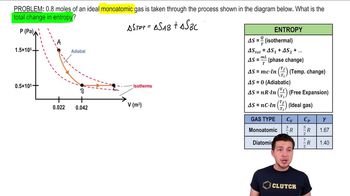
Entropy & Ideal Gas Processes

Ideal Gas Law

The ideal gas law is a fundamental equation that relates the pressure, volume, and temperature of an ideal gas through the equation PV = nRT, where P is pressure, V is volume, n is the number of moles, R is the ideal gas constant, and T is temperature. This law helps in understanding how gases behave under different conditions, although it assumes no interactions between gas molecules.
Recommended video:
Guided course
07:21
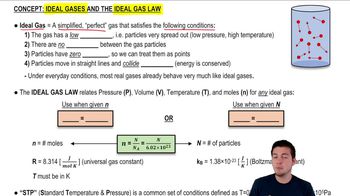
Ideal Gases and the Ideal Gas Law

Adiabatic Equation for Ideal Gases

For an adiabatic process involving an ideal gas, the relationship between pressure and volume is given by the equation PV^γ = constant, where γ (gamma) is the heat capacity ratio (Cp/Cv). This equation allows us to calculate the final pressure of the gas after adiabatic compression or expansion, given the initial conditions and the final volume.
Recommended video:
Guided course
07:21
Ideal Gases and the Ideal Gas Law
Related Practice
Textbook Question

An experimenter adds 970970 J of heat to 1.751.75 mol of an ideal gas to heat it from 10.010.0°C to 25.025.0°C at constant pressure. The gas does +223+223 J of work during the expansion. Calculate γ\(\gamma\) for the gas.

1
views
Textbook Question

A monatomic ideal gas that is initially at 1.50×1051.50\(\times\)10^5 Pa and has a volume of 0.08000.0800 m3 is compressed adiabatically to a volume of 0.04000.0400 m3. What is the ratio of the final temperature of the gas to its initial temperature? Is the gas heated or cooled by this compression?

1
views
Textbook Question

Five moles of monatomic ideal gas have initial pressure 2.50×1032.50\(\times\)10^3 Pa and initial volume 2.102.10 m3. While undergoing an adiabatic expansion, the gas does 14801480 J of work. What is the final pressure of the gas after the expansion?

Textbook Question

A player bounces a basketball on the floor, compressing it to 80.0%80.0\% of its original volume. The air (assume it is essentially N2 gas) inside the ball is originally at 20.020.0°C and 2.002.00 atm. The ball's inside diameter is 23.9 23.9 cm. What temperature does the air in the ball reach at its maximum compression? Assume the compression is adiabatic and treat the gas as ideal.

Textbook Question

The temperature of 0.1500.150 mol of an ideal gas is held constant at 77.077.0°C while its volume is reduced to 25.0%25.0\% of its initial volume. The initial pressure of the gas is 1.251.25 atm. Does the gas exchange heat with its surroundings? If so, how much? Does the gas absorb or liberate heat?

4
views
Textbook Question

Heat QQ flows into a monatomic ideal gas, and the volume increases while the pressure is kept constant. What fraction of the heat energy is used to do the expansion work of the gas?

3
views