
Ch 19: The First Law of Thermodynamics
Young & Freedman Calc - University Physics 15th Edition
Young & Freedman Calc15th EditionUniversity PhysicsISBN: 9780135159552Not the one you use?Change textbook
Chapter 19, Problem 32b

A cylinder contains 0.100 mol of an ideal monatomic gas. Initially the gas is at 1.00×1051.00\(\times\)10^5 Pa and occupies a volume of 2.50×1032.50\(\times\)10^{-3} m3. If the gas is allowed to expand to twice the initial volume, find the final temperature (in kelvins) and pressure of the gas if the expansion is (i) isothermal; (ii) isobaric; (iii) adiabatic.

Verified step by step guidance
1
Step 1: Begin by identifying the given values and the relationships between pressure, volume, and temperature for an ideal gas. The initial pressure (P₁) is 1.00 × 10⁵ Pa, the initial volume (V₁) is 2.50 × 10⁻³ m³, and the initial number of moles (n) is 0.100 mol. Use the ideal gas law, \( PV = nRT \), to calculate the initial temperature \( T₁ \). Rearrange the formula to \( T₁ = \frac{P₁V₁}{nR} \), where \( R \) is the universal gas constant (8.314 J/(mol·K)).
Step 2: For part (i), the isothermal expansion means the temperature remains constant. Since \( T \) is constant, the ideal gas law simplifies to \( P₁V₁ = P₂V₂ \). The final volume \( V₂ \) is twice the initial volume, so \( V₂ = 2V₁ \). Rearrange the equation to solve for the final pressure \( P₂ \): \( P₂ = \frac{P₁V₁}{V₂} \). Substitute the known values to find \( P₂ \). The final temperature \( T \) remains equal to \( T₁ \).
Step 3: For part (ii), the isobaric expansion means the pressure remains constant. Since \( P \) is constant, the ideal gas law simplifies to \( \frac{V₁}{T₁} = \frac{V₂}{T₂} \). Rearrange the equation to solve for the final temperature \( T₂ \): \( T₂ = \frac{V₂T₁}{V₁} \). Substitute the known values to find \( T₂ \). The final pressure \( P \) remains equal to \( P₁ \).
Step 4: For part (iii), the adiabatic expansion means no heat is exchanged with the surroundings. Use the adiabatic condition for an ideal monatomic gas: \( P₁V₁^\gamma = P₂V₂^\gamma \), where \( \gamma = \frac{5}{3} \) for a monatomic gas. Rearrange the equation to solve for \( P₂ \): \( P₂ = P₁ \left( \frac{V₁}{V₂} \right)^\gamma \). Substitute the known values to find \( P₂ \). Then use the ideal gas law \( T₂ = \frac{P₂V₂}{nR} \) to find the final temperature \( T₂ \).
Step 5: Summarize the results for each case: (i) Isothermal expansion keeps temperature constant and uses \( P₁V₁ = P₂V₂ \) to find \( P₂ \). (ii) Isobaric expansion keeps pressure constant and uses \( \frac{V₁}{T₁} = \frac{V₂}{T₂} \) to find \( T₂ \). (iii) Adiabatic expansion uses \( P₁V₁^\gamma = P₂V₂^\gamma \) to find \( P₂ \), and \( T₂ = \frac{P₂V₂}{nR} \) to find \( T₂ \).

Verified video answer for a similar problem:

This video solution was recommended by our tutors as helpful for the problem above.
Video duration:
5m
Was this helpful?

Key Concepts

Here are the essential concepts you must grasp in order to answer the question correctly.

Ideal Gas Law

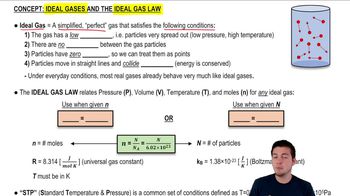
The Ideal Gas Law relates the pressure, volume, temperature, and number of moles of an ideal gas through the equation PV = nRT. Here, P is pressure, V is volume, n is the number of moles, R is the ideal gas constant, and T is temperature in kelvins. This law is fundamental for understanding how changes in one property affect the others in gas behavior.
Recommended video:
Guided course
07:21
Ideal Gases and the Ideal Gas Law

Types of Thermodynamic Processes

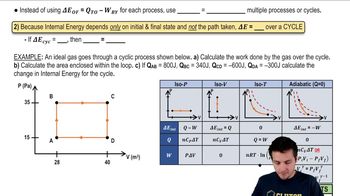
Thermodynamic processes can be classified into isothermal (constant temperature), isobaric (constant pressure), and adiabatic (no heat exchange). Each process has distinct characteristics that affect how a gas behaves when it expands or contracts. Understanding these processes is crucial for predicting changes in temperature and pressure during gas expansion.
Recommended video:
Guided course
08:45
Properties of Cyclic Thermodynamic Processes

Monatomic Ideal Gas Properties

Monatomic ideal gases, such as helium or neon, consist of single atoms and exhibit specific heat capacities that differ from diatomic or polyatomic gases. For monatomic gases, the molar specific heat at constant volume (Cv) is 3/2 R, and at constant pressure (Cp) is 5/2 R. These properties are essential for calculating temperature and pressure changes during various thermodynamic processes.
Recommended video:
Guided course
07:21
Ideal Gases and the Ideal Gas Law