Helium gas with a volume of L, under a pressure of atm and at °C, is warmed until both pressure and volume are doubled. What is the final temperature?
Ch 18: Thermal Properties of Matter
Young & Freedman Calc15th EditionUniversity PhysicsISBN: 9780135159552Not the one you use?Change textbook
Chapter 18, Problem 1b
A -L tank contains kg of helium at °C. The molar mass of helium is g/mol. What is the pressure in the tank, in pascals and in atmospheres?
Verified step by step guidance1
First, convert the mass of helium from kilograms to grams. Since 1 kg = 1000 g, multiply 4.86 * 10^-4 kg by 1000 to get the mass in grams.
Next, calculate the number of moles of helium using the formula: \( n = \frac{\text{mass}}{\text{molar mass}} \). Use the mass in grams and the molar mass of helium, which is 4.00 g/mol.
Convert the temperature from Celsius to Kelvin using the formula: \( T(K) = T(°C) + 273.15 \). Add 273.15 to 18.0°C to find the temperature in Kelvin.
Use the ideal gas law to find the pressure in pascals: \( PV = nRT \). Rearrange the formula to solve for pressure: \( P = \frac{nRT}{V} \). Use \( R = 8.314 \text{ J/(mol·K)} \) for the ideal gas constant, the number of moles \( n \), the temperature in Kelvin \( T \), and the volume \( V \) in liters converted to cubic meters (1 L = 0.001 m³).
Finally, convert the pressure from pascals to atmospheres using the conversion factor: 1 atm = 101325 Pa. Divide the pressure in pascals by 101325 to find the pressure in atmospheres.

Verified video answer for a similar problem:
This video solution was recommended by our tutors as helpful for the problem above.
Video duration:
6mWas this helpful?
Key Concepts
Here are the essential concepts you must grasp in order to answer the question correctly.
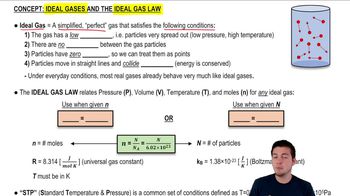
Ideal Gas Law
The Ideal Gas Law is a fundamental equation in physics that relates the pressure, volume, temperature, and number of moles of a gas. It is expressed as PV = nRT, where P is pressure, V is volume, n is the number of moles, R is the ideal gas constant, and T is temperature in Kelvin. This law assumes that the gas behaves ideally, meaning interactions between molecules are negligible.
Recommended video:
Guided course
Ideal Gases and the Ideal Gas Law
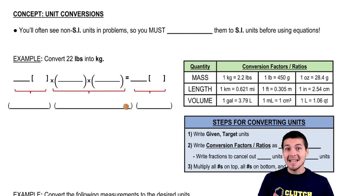
Conversion of Units
Conversion of units is essential in physics to ensure consistency and accuracy in calculations. In this problem, pressure needs to be expressed in both pascals and atmospheres. Knowing that 1 atmosphere is equivalent to 101,325 pascals allows for conversion between these units. Proper unit conversion is crucial for interpreting results correctly and comparing them with standard values.
Recommended video:
Guided course
Unit Conversions
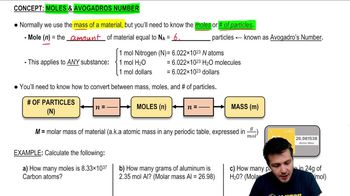
Molar Mass and Moles Calculation
Molar mass is the mass of one mole of a substance, expressed in grams per mole. To find the number of moles of helium in the tank, divide the mass of helium by its molar mass (4.00 g/mol). This calculation is necessary to apply the Ideal Gas Law, as the number of moles (n) is a key variable in determining the pressure of the gas.
Recommended video:
Guided course
Moles & Avogadro's Number
Related Practice
Textbook Question
1
views
Textbook Question
A -L tank contains kg of helium at °C. The molar mass of helium is g/mol. How many moles of helium are in the tank?
1
views
Textbook Question
Helium gas with a volume of L, under a pressure of atm and at °C, is warmed until both pressure and volume are doubled. How many grams of helium are there? The molar mass of helium is g/mol.
3
views
Textbook Question
A cylindrical tank has a tight-fitting piston that allows the volume of the tank to be changed. The tank originally contains m3 of air at a pressure of atm. The piston is slowly pulled out until the volume of the gas is increased to m3. If the temperature remains constant, what is the final value of the pressure?
3
views