
Ch 15: Mechanical Waves
Young & Freedman Calc - University Physics 15th Edition
Young & Freedman Calc15th EditionUniversity PhysicsISBN: 9780135159552Not the one you use?Change textbook
Chapter 15, Problem 38a

A piano tuner stretches a steel piano wire with a tension of 800 N. The steel wire is 0.400 m long and has a mass of 3.00 g. What is the frequency of its fundamental mode of vibration?

Verified step by step guidance
1
First, convert the mass of the wire from grams to kilograms to ensure consistency in units. Since 1 g = 0.001 kg, the mass of the wire is 0.003 kg.
Calculate the linear mass density (μ) of the wire, which is the mass per unit length. Use the formula: μ = mass / length. Substitute the given values: μ = 0.003 kg / 0.400 m.
Determine the speed of the wave on the wire using the formula: v = sqrt(T / μ), where T is the tension in the wire. Substitute the given tension and the calculated linear mass density into the formula.
The fundamental frequency (f) of a vibrating string is given by the formula: f = v / (2 * L), where L is the length of the wire. Use the speed of the wave calculated in the previous step and the given length of the wire.
Substitute the values into the formula for the fundamental frequency to find the frequency of the wire's fundamental mode of vibration. Ensure all units are consistent to obtain the frequency in hertz (Hz).

Verified video answer for a similar problem:

This video solution was recommended by our tutors as helpful for the problem above.
Video duration:
5m
Was this helpful?

Key Concepts

Here are the essential concepts you must grasp in order to answer the question correctly.

Wave Speed on a String

The speed of a wave on a string is determined by the tension in the string and its linear mass density. It is given by the formula v = sqrt(T/μ), where T is the tension and μ is the mass per unit length. This relationship is crucial for understanding how the physical properties of the string affect wave propagation.
Recommended video:
Guided course
04:39
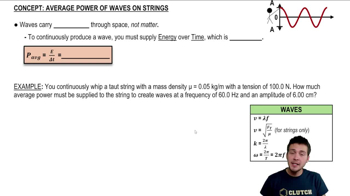
Energy & Power of Waves on Strings

Linear Mass Density

Linear mass density (μ) is the mass of the string per unit length, calculated as μ = m/L, where m is the mass and L is the length of the string. It is a key factor in determining the wave speed on the string, influencing the frequency of vibration modes.
Recommended video:
Guided course
04:33
Problems with Mass, Volume, & Density

Fundamental Frequency of a Vibrating String

The fundamental frequency of a vibrating string is the lowest frequency at which the string vibrates. It is given by f = v/(2L), where v is the wave speed and L is the length of the string. This frequency is essential for understanding the pitch produced by the string when it vibrates.
Recommended video:
Guided course
04:39
Energy & Power of Waves on Strings
Related Practice
Textbook Question

A wire with mass 40.0 g is stretched so that its ends are tied down at points 80.0 cm apart. The wire vibrates in its fundamental mode with frequency 60.0 Hz and with an amplitude at the antinodes of 0.300 cm. What is the speed of propagation of transverse waves in the wire?

2
views
Textbook Question

A 1.50-m-long rope is stretched between two supports with a tension that makes the speed of transverse waves 62.0 m/s.What are the wavelength and frequency of the second overtone?

1
views
Textbook Question

CALC. A thin, taut string tied at both ends and oscillating in its third harmonic has its shape described by the equation y(x,t)=(5.60 cm)sin[(0.0340 rad/cm)x]sin[(50.0 rad/s)t]y(x,t)=(5.60\(\text{ cm}\))\(\sin\)[(0.0340\(\text{ rad/cm}\))x]\(\sin\)[(50.0\(\text{ rad/s}\))t], where the origin is at the left end of the string, the xx-axis is along the string, and the yy-axis is perpendicular to the string. Draw a sketch that shows the standing-wave pattern.

Textbook Question

The wave function of a standing wave is y(x,t)=4.44 mmsin[(32.5 rad/m)x]sin[(754rad/s)t]y(x,t)=4.44\(\text{ mm}\]\sin\)[(32.5\(\text{ rad/m}\))x]\(\sin\)[(754\(\text{rad/s}\))t]. For the two traveling waves that make up this standing wave, find the wavelength.

1
views
Textbook Question

The wave function of a standing wave is y(x,t)=4.44 mmsin[(32.5 rad/m)x]sin[(754rad/s)t]y(x,t)=4.44\(\text{ mm}\]\sin\)[(32.5\(\text{ rad/m}\))x]\(\sin\)[(754\(\text{rad/s}\))t]. For the two traveling waves that make up this standing wave, find the amplitude.

1
views
Textbook Question

A 1.50-m-long rope is stretched between two supports with a tension that makes the speed of transverse waves 62.0 m/s.What are the wavelength and frequency of the fourth harmonic?