

Ch 14: Periodic Motion
Young & Freedman Calc - University Physics 15th Edition
Young & Freedman Calc15th EditionUniversity PhysicsISBN: 9780135159552Not the one you use?Change textbook
Chapter 14, Problem 5

A machine part is undergoing SHM with a frequency of 4.00 Hz and amplitude 1.80 cm. How long does it take the part to go from x = 0 to x = -1.80 cm ?

Verified step by step guidance
1
Start by understanding the concept of Simple Harmonic Motion (SHM). SHM is a type of periodic motion where the restoring force is directly proportional to the displacement and acts in the direction opposite to that of displacement.
Identify the given parameters: frequency (f) = 4.00 Hz and amplitude (A) = 1.80 cm. The displacement we are interested in is from x = 0 to x = -1.80 cm.
Use the formula for the period of SHM, which is the reciprocal of frequency: \( T = \frac{1}{f} \). Calculate the period using the given frequency.
The displacement in SHM can be described by the equation \( x(t) = A \cos(\omega t + \phi) \), where \( \omega = 2\pi f \) is the angular frequency. Since the motion starts from x = 0, the phase angle \( \phi \) is \( \frac{\pi}{2} \).
Determine the time it takes to reach x = -1.80 cm by solving the equation \( x(t) = A \cos(\omega t + \phi) \) for t, using the known values of A, \( \omega \), and \( \phi \).

Verified video answer for a similar problem:

This video solution was recommended by our tutors as helpful for the problem above.
Video duration:
3m
Was this helpful?

Key Concepts

Here are the essential concepts you must grasp in order to answer the question correctly.

Simple Harmonic Motion (SHM)

Simple Harmonic Motion is a type of periodic motion where an object oscillates back and forth through an equilibrium position. The motion is characterized by a restoring force proportional to the displacement, often described by sine or cosine functions. Understanding SHM is crucial for analyzing the motion of the machine part in the problem.
Recommended video:
Guided course
07:52
Simple Harmonic Motion of Pendulums

Frequency and Period of SHM

Frequency, measured in Hertz (Hz), is the number of oscillations per second in SHM. The period is the time taken for one complete cycle of motion and is the inverse of frequency. In this problem, the frequency is given as 4.00 Hz, which helps determine the period and subsequently the time taken for specific displacements.
Recommended video:
Guided course
05:08
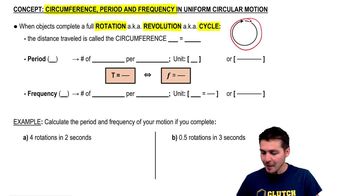
Circumference, Period, and Frequency in UCM

Phase and Displacement in SHM

In SHM, the phase determines the position and direction of motion at any given time. The displacement is the distance from the equilibrium position. For this problem, understanding how the phase relates to displacement allows us to calculate the time taken for the part to move from x = 0 to x = -1.80 cm, considering the amplitude and frequency.
Recommended video:
Guided course
08:59
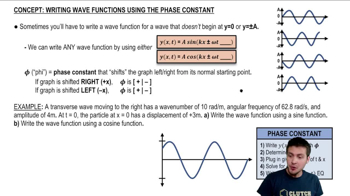
Phase Constant of a Wave Function
Related Practice
Textbook Question

In a physics lab, you attach a 0.200-kg air-track glider to the end of an ideal spring of negligible mass and start it oscillating. The elapsed time from when the glider first moves through the equilibrium point to the second time it moves through that point is 2.60 s. Find the spring's force constant.

1
views
Textbook Question

The displacement of an oscillating object as a function of time is shown in Fig. E14.4. What is (c) the period? (d) the angular frequency of this motion?

2
views
Textbook Question

A 2.40-kg ball is attached to an unknown spring and allowed to oscillate. Figure E14.7 shows a graph of the ball's position x as a function of time t. What are the oscillation's (a) period, (b) frequency, (c) angular frequency, and (d) amplitude? (e) What is the force constant of the spring?

2
views
Textbook Question

Music. When a person sings, his or her vocal cords vibrate in a repetitive pattern that has the same frequency as the note that is sung. If someone sings the note B flat, which has a frequency of 466 Hz, how much time does it take the person's vocal cords to vibrate through one complete cycle, and what is the angular frequency of the cords?

1
views
Textbook Question

The displacement of an oscillating object as a function of time is shown in Fig. E14.4. What is (a) the frequency? (b) the amplitude?

2
views
Textbook Question

An object is undergoing SHM with period 0.900 s and amplitude 0.320 m. At t = 0 the object is at x = 0.320 m and is instantaneously at rest. Calculate the time it takes the object to go (a) from x = 0.320 m to x = 0.160 m. (b) from x = 0.160 m to x = 0.

2
views
1
rank