Ch 14: Periodic Motion
Young & Freedman Calc - University Physics 15th Edition
Young & Freedman Calc15th EditionUniversity PhysicsISBN: 9780135159552Not the one you use?Change textbook
Chapter 14, Problem 45

A building in San Francisco has light fixtures consisting of small 2.35-kg bulbs with shades hanging from the ceiling at the end of light, thin cords 1.50 m long. If a minor earthquake occurs, how many swings per second will these fixtures make?

Verified step by step guidance
1
Identify the problem as a simple pendulum problem, where the light fixture acts as a pendulum bob. The frequency of a simple pendulum depends on the length of the pendulum and the acceleration due to gravity.
Recall the formula for the period of a simple pendulum: T=2πlg, where l is the length of the pendulum and g is the acceleration due to gravity (approximately 9.81 m/s²).
Substitute the given length of the cord, l=1.50 m, into the period formula: T=2π1.509.81.
Calculate the period T using the formula. This will give you the time it takes for one complete swing back and forth.
Determine the frequency of the pendulum, which is the number of swings per second, by taking the reciprocal of the period: f=1T.

Verified video answer for a similar problem:

This video solution was recommended by our tutors as helpful for the problem above.
Video duration:
2m
Was this helpful?

Key Concepts

Here are the essential concepts you must grasp in order to answer the question correctly.

Simple Harmonic Motion

Simple harmonic motion describes the oscillatory motion of objects like pendulums, where the restoring force is proportional to the displacement. In this context, the light fixtures act as pendulums, swinging back and forth due to gravitational forces, which can be modeled using the principles of simple harmonic motion.
Recommended video:
Guided course
07:52
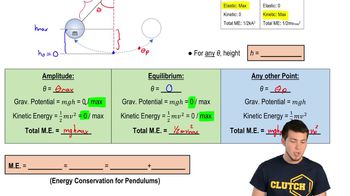
Simple Harmonic Motion of Pendulums

Pendulum Formula

The period of a simple pendulum is determined by the formula T = 2π√(L/g), where T is the period, L is the length of the pendulum, and g is the acceleration due to gravity. This formula helps calculate the time it takes for one complete swing, which is essential for determining the frequency of oscillation during an earthquake.
Recommended video:
Guided course
06:53
Energy in Pendulums

Frequency of Oscillation

Frequency refers to the number of complete cycles or swings per second, calculated as the inverse of the period (f = 1/T). Understanding frequency is crucial for determining how many swings per second the light fixtures will make during an earthquake, providing insight into their oscillatory behavior.
Recommended video:
Guided course
05:08
Circumference, Period, and Frequency in UCM