

Ch 13: Gravitation
Young & Freedman Calc - University Physics 15th Edition
Young & Freedman Calc15th EditionUniversity PhysicsISBN: 9780135159552Not the one you use?Change textbook
Chapter 13, Problem 17

Use the results of Example 13.5 (Section 13.3) to calculate the escape speed for a spacecraft (a) from the surface of Mars and (b) from the surface of Jupiter. Use the data in Appendix F. (c) Why is the escape speed for a spacecraft independent of the spacecraft's mass?

Verified step by step guidance
1
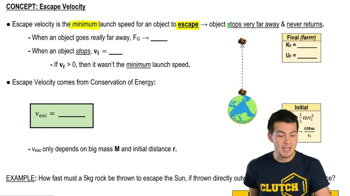
To calculate the escape speed, use the formula: \( v_{e} = \sqrt{\frac{2GM}{R}} \), where \( G \) is the gravitational constant, \( M \) is the mass of the planet, and \( R \) is the radius of the planet.
For part (a), substitute the mass and radius of Mars into the escape speed formula. Use the values: \( M_{Mars} = 6.42 \times 10^{23} \text{ kg} \) and \( R_{Mars} = 3.39 \times 10^{6} \text{ m} \).
For part (b), substitute the mass and radius of Jupiter into the escape speed formula. Use the values: \( M_{Jupiter} = 1.90 \times 10^{27} \text{ kg} \) and \( R_{Jupiter} = 6.99 \times 10^{7} \text{ m} \).
Calculate the escape speed for each planet by plugging the respective values into the formula and solving for \( v_{e} \).
For part (c), understand that the escape speed is independent of the spacecraft's mass because the formula \( v_{e} = \sqrt{\frac{2GM}{R}} \) does not include the mass of the spacecraft. The escape speed depends only on the gravitational parameters of the planet.

Verified video answer for a similar problem:

This video solution was recommended by our tutors as helpful for the problem above.
Video duration:
6m
Was this helpful?

Key Concepts

Here are the essential concepts you must grasp in order to answer the question correctly.

Escape Speed

Escape speed is the minimum speed needed for an object to break free from the gravitational pull of a celestial body without further propulsion. It depends on the mass and radius of the body being escaped from, calculated using the formula v = sqrt(2GM/R), where G is the gravitational constant, M is the mass of the celestial body, and R is its radius.
Recommended video:
Guided course
7:27
Escape Velocity

Gravitational Constant

The gravitational constant (G) is a fundamental constant in physics that quantifies the strength of the gravitational force between two masses. Its value is approximately 6.674 × 10^-11 N(m/kg)^2. It is crucial in calculating gravitational forces and escape speeds, as it relates the mass and distance between objects to the force exerted.
Recommended video:
Guided course
08:59
Phase Constant of a Wave Function

Independence from Mass

The escape speed is independent of the mass of the spacecraft because the gravitational force and the required kinetic energy both scale with mass. As the mass increases, the gravitational pull increases proportionally, but so does the kinetic energy needed to escape, resulting in mass canceling out in the escape speed formula, leaving it dependent only on the celestial body's properties.
Recommended video:
Guided course
20:32
Mass Spectrometers
Related Practice
Textbook Question

Titania, the largest moon of the planet Uranus, has 1/8 the radius of the earth and 1/1700 the mass of the earth. What is the average density of Titania? (This is less than the density of rock, which is one piece of evidence that Titania is made primarily of ice.)

2
views
Textbook Question

Jupiter's moon Io has active volcanoes (in fact, it is the most volcanically active body in the solar system) that eject material as high as 500 km (or even higher) above the surface. Io has a mass of 8.93 × 10²² kg and a radius of 1821 km. For this calculation, ignore any variation in gravity over the 500-km range of the debris. How high would this material go on earth if it were ejected with the same speed as on Io?

1
views
Textbook Question

Ten days after it was launched toward Mars in December 1998, the Mars Climate Orbiter spacecraft (mass 629 kg) was 2.87 × 10⁶ km from the earth and traveling at 1.20 × 10⁴ km/h relative to the earth. At this time, what were (a) the spacecraft's kinetic energy relative to the earth and (b) the potential energy of the earth–spacecraft system?

Textbook Question

For a satellite to be in a circular orbit 890 km above the surface of the earth, what orbital speed must it be given?

1
views
Textbook Question

Titania, the largest moon of the planet Uranus, has 1/8 the radius of the earth and 1/1700 the mass of the earth. What is the acceleration due to gravity at the surface of Titania?

3
views
Textbook Question

A planet orbiting a distant star has radius 3.24 × 10⁶ m. The escape speed for an object launched from this planet’s surface is 7.65 × 10³ m/s. What is the acceleration due to gravity at the surface of the planet?

1
views