
You decide to visit Santa Claus at the north pole to put in a good word about your splendid behavior throughout the year. While there, you notice that the elf Sneezy, when hanging from a rope, produces a tension of 395.0 N in the rope. If Sneezy hangs from a similar rope while delivering presents at the earth's equator, what will the tension in it be? (Recall that the earth is rotating about an axis through its north and south poles.)
In 2005 astronomers announced the discovery of a large black hole in the galaxy Markarian 766 having clumps of matter orbiting around once every 27 hours and moving at 30,000 km/s. What is the mass of this black hole, assuming circular orbits? Express your answer in kilograms and as a multiple of our sun's mass.
Verified step by step guidance
Verified video answer for a similar problem:
Key Concepts
Gravitational Force and Circular Orbits
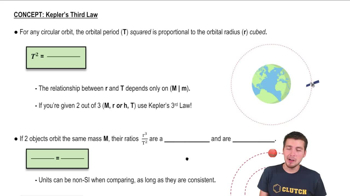
Kepler's Third Law of Planetary Motion
Mass of the Sun
Astronomers have observed a small, massive object at the center of our Milky Way galaxy. A ring of material orbits this massive object; the ring has a diameter of about 15 light-years and an orbital speed of about 200 km/s. Observations of stars, as well as theories of the structure of stars, suggest that it is impossible for a single star to have a mass of more than about 50 solar masses. Can this massive object be a single, ordinary star?
In 2005 astronomers announced the discovery of a large black hole in the galaxy Markarian 766 having clumps of matter orbiting around once every 27 hours and moving at 30,000 km/s. How far are these clumps from the center of the black hole?
In 2005 astronomers announced the discovery of a large black hole in the galaxy Markarian 766 having clumps of matter orbiting around once every 27 hours and moving at 30,000 km/s. What is the radius of its event horizon?
