
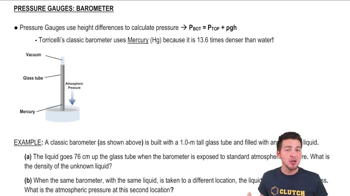
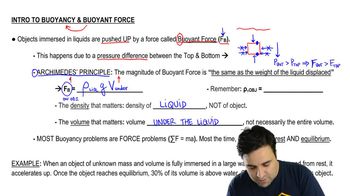
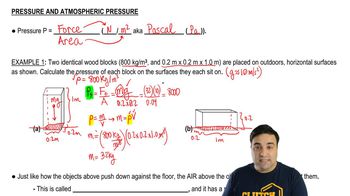
In intravenous feeding, a needle is inserted in a vein in the patient's arm and a tube leads from the needle to a reservoir of fluid (density 1050 kg/m3) located at height h above the arm. The top of the reservoir is open to the air. If the gauge pressure inside the vein is 5980 Pa, what is the minimum value of h that allows fluid to enter the vein? Assume the needle diameter is large enough that you can ignore the viscosity of the liquid.
You are designing a diving bell to withstand the pressure of seawater at a depth of 250 m. What is the gauge pressure at this depth? (You can ignore changes in the density of the water with depth.) At this depth, what is the net force due to the water outside and the air inside the bell on a circular glass window 30.0 cm in diameter if the pressure inside the diving bell equals the pressure at the surface of the water? (Ignore the small variation of pressure over the surface of the window.)
Verified step by step guidance
Verified video answer for a similar problem:
Key Concepts
Gauge Pressure
Buoyancy and Net Force
Pressure and Area Relationship
You are designing a diving bell to withstand the pressure of seawater at a depth of 250 m. (a) What is the gauge pressure at this depth? (You can ignore changes in the density of the water with depth.)
The liquid in the open-tube manometer in Fig. 12.8a is mercury, y1=3.00 cm,and y2=7.00 cm. Atmospheric pressure is 980 millibars. What is (a) the absolute pressure at the bottom of the U-shaped tube; (b) the absolute pressure in the open tube at a depth of 4.00 cm below the free surface; (c) the absolute pressure of the gas in the container; (d) the gauge pressure of the gas in pascals?
BIO. There is a maximum depth at which a diver can breathe through a snorkel tube (Fig. E12.17) because as the depth increases, so does the pressure difference, which tends to collapse the diver's lungs. Since the snorkel connects the air in the lungs to the atmosphere at the surface, the pressure inside the lungs is atmospheric pressure. What is the external– internal pressure difference when the diver's lungs are at a depth of 6.1 m (about 20 ft)? Assume that the diver is in fresh-water. (A scuba diver breathing from compressed air tanks can operate at greater depths than can a snorkeler, since the pressure of the air inside the scuba diver's lungs increases to match the external pressure of the water.)
Ear Damage from Diving. If the force on the tympanic membrane (eardrum) increases by about 1.5 N above the force from atmospheric pressure, the membrane can be damaged. When you go scuba diving in the ocean, below what depth could damage to your eardrum start to occur? The eardrum is typically 8.2 mm in diameter. (Consult Table 12.1.)
A barrel contains a 0.120-m layer of oil floating on water that is 0.250 m deep. The density of the oil is 600 kg/m3. (a) What is the gauge pressure at the oil–water interface? (b) What is the gauge pressure at the bottom of the barrel?
