
A hollow plastic sphere is held below the surface of a freshwater lake by a cord anchored to the bottom of the lake. The sphere has a volume of 0.650 m3 and the tension in the cord is 1120 N. The cord breaks and the sphere rises to the surface. When the sphere comes to rest, what fraction of its volume will be submerged?
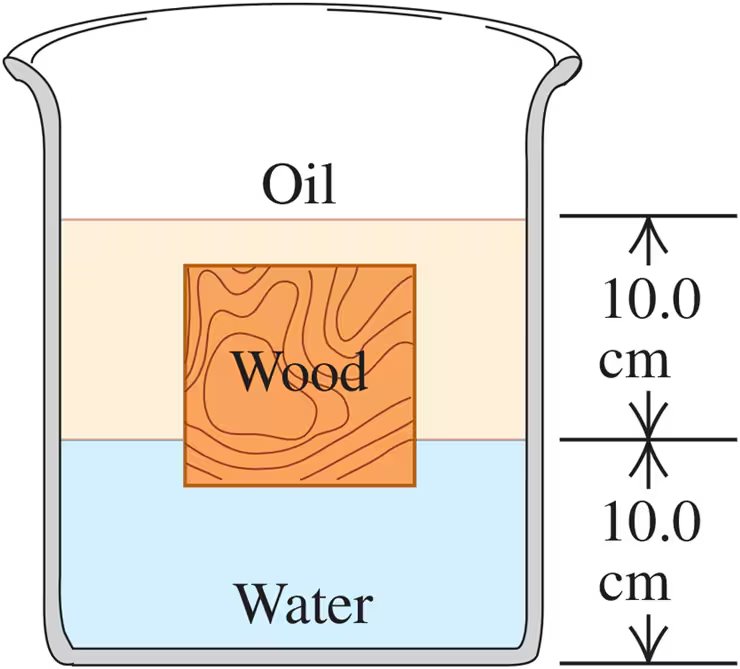
A cubical block of wood, 10.0 cm on a side, floats at the interface between oil and water with its lower surface 1.50 cm below the interface (Fig. E12.33). The density of the oil is 790 kg/m3. (a) What is the gauge pressure at the upper face of the block? (b) What is the gauge pressure at the lower face of the block?

Verified step by step guidance
Verified video answer for a similar problem:
Key Concepts
Buoyancy
Gauge Pressure
Density
A hollow plastic sphere is held below the surface of a freshwater lake by a cord anchored to the bottom of the lake. The sphere has a volume of 0.650 m3 and the tension in the cord is 1120 N. (a) Calculate the buoyant force exerted by the water on the sphere. (b) What is the mass of the sphere?
A shower head has 20 circular openings, each with radius 1.0 mm. The shower head is connected to a pipe with radius 0.80 cm. If the speed of water in the pipe is 3.0 m/s, what is its speed as it exits the shower-head openings?
A soft drink (mostly water) flows in a pipe at a beverage plant with a mass flow rate that would fill 220 0.355-L cans per minute. At point 2 in the pipe, the gauge pressure is 152 kPa and the cross-sectional area is 8.00 cm2. At point 1, 1.35 m above point 2, the cross-sectional area is 2.00 cm2. Find the (b) volume flow rate. (c) flow speeds at points 1 and 2.
Water is flowing in a pipe with a varying cross-sectional area, and at all points the water completely fills the pipe. At point 1 the cross-sectional area of the pipe is 0.070 m2, and the magnitude of the fluid velocity is 3.50 m/s. (c) Calculate the volume of water discharged from the open end of the pipe in 1.00 hour.
A cubical block of wood, 10.0 cm on a side, floats at the interface between oil and water with its lower surface 1.50 cm below the interface (Fig. E12.33). The density of the oil is 790 kg/m3. (a) What is the gauge pressure at the upper face of the block? (b) What is the gauge pressure at the lower face of the block?
