
Ch 10: Dynamics of Rotational Motion
Young & Freedman Calc - University Physics 15th Edition
Young & Freedman Calc15th EditionUniversity PhysicsISBN: 9780135159552Not the one you use?Change textbook
Chapter 10, Problem 11b

A machine part has the shape of a solid uniform sphere of mass 225 g and diameter 3.00 cm. It is spinning about a frictionless axle through its center, but at one point on its equator it is scraping against metal, resulting in a friction force of 0.0200 N at that point. How long will it take to decrease its rotational speed by 22.5 rad/s?

Verified step by step guidance
1
First, convert the mass of the sphere from grams to kilograms. Since 1 g = 0.001 kg, the mass of the sphere is 225 g * 0.001 kg/g = 0.225 kg.
Next, calculate the moment of inertia (I) of the sphere. For a solid sphere, the moment of inertia about an axis through its center is given by the formula: I=25mr2, where m is the mass and r is the radius. The radius is half the diameter, so r = 3.00 cm / 2 = 1.50 cm = 0.015 m.
Calculate the torque (τ) due to the friction force. Torque is given by the formula: τ=Fr, where F is the friction force and r is the radius of the sphere. Substitute the values: F = 0.0200 N and r = 0.015 m.
Use the relationship between torque and angular deceleration (α) given by: τ=Iα. Solve for α using the previously calculated values of τ and I.
Finally, use the formula for angular deceleration to find the time (t) it takes to decrease the rotational speed by 22.5 rad/s. The formula is: ω=ωi-αt, where ω is the final angular speed (0 rad/s), ωi is the initial angular speed (22.5 rad/s), and α is the angular deceleration. Solve for t.

Verified video answer for a similar problem:

This video solution was recommended by our tutors as helpful for the problem above.
Video duration:
9m
Was this helpful?

Key Concepts

Here are the essential concepts you must grasp in order to answer the question correctly.

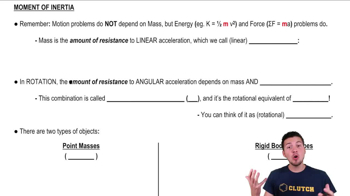
Moment of Inertia

The moment of inertia is a measure of an object's resistance to changes in its rotational motion. For a solid sphere, it is calculated using the formula I = 2/5 * m * r^2, where m is the mass and r is the radius. This concept is crucial for determining how the sphere's rotational speed changes when subjected to external forces.
Recommended video:
Guided course
11:47
Intro to Moment of Inertia

Torque

Torque is the rotational equivalent of force, causing an object to rotate around an axis. It is calculated as the product of the force applied and the distance from the axis of rotation, τ = r * F. In this scenario, the friction force at the equator generates a torque that affects the sphere's rotational speed.
Recommended video:
Guided course
08:55
Net Torque & Sign of Torque

Angular Deceleration

Angular deceleration refers to the rate at which an object's rotational speed decreases. It is determined by the net torque acting on the object divided by its moment of inertia, α = τ/I. Understanding this concept helps in calculating the time required for the sphere's rotational speed to decrease by a specified amount.
Recommended video:
Guided course
12:12
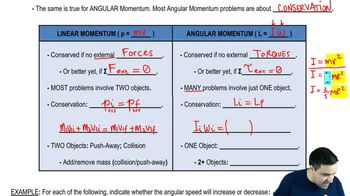
Conservation of Angular Momentum
Related Practice
Textbook Question

A cord is wrapped around the rim of a solid uniform wheel 0.250 m in radius and of mass 9.20 kg. A steady horizontal pull of 40.0 N to the right is exerted on the cord, pulling it off tangentially from the wheel. The wheel is mounted on frictionless bearings on a horizontal axle through its center. Find the magnitude and direction of the force that the axle exerts on the wheel.

3
views
Textbook Question

A 2.00-kg textbook rests on a frictionless, horizontal surface. A cord attached to the book passes over a pulley whose diameter is 0.150 m, to a hanging book with mass 3.00 kg. The system is released from rest, and the books are observed to move 1.20 m in 0.800 s. What is the tension in each part of the cord?

2
views
Textbook Question

A stone is suspended from the free end of a wire that is wrapped around the outer rim of a pulley, similar to what is shown in Fig. 10.10. The pulley is a uniform disk with mass 10.0 kg and radius 30.0 cm and turns on frictionless bearings. You measure that the stone travels 12.6 m in the first 3.00 s starting from rest. Find the tension in the wire.

1
views
Textbook Question

(a) Calculate the magnitude of the angular momentum of the earth in a circular orbit around the sun. Is it reasonable to model it as a particle? Consult Appendix E and the astronomical data in Appendix F

1
views
Textbook Question

A stone is suspended from the free end of a wire that is wrapped around the outer rim of a pulley, similar to what is shown in Fig. 10.10. The pulley is a uniform disk with mass 10.0 kg and radius 30.0 cm and turns on frictionless bearings. You measure that the stone travels 12.6 m in the first 3.00 s starting from rest. Find the mass of the stone.

2
views
Textbook Question

A machine part has the shape of a solid uniform sphere of mass 225 g and diameter 3.00 cm. It is spinning about a frictionless axle through its center, but at one point on its equator, it is scraping against metal, resulting in a friction force of 0.0200 N at that point. Find its angular acceleration.

1
views