Ch 08: Momentum, Impulse, and Collisions
Young & Freedman Calc - University Physics 15th Edition
Young & Freedman Calc15th EditionUniversity PhysicsISBN: 9780135159552Not the one you use?Change textbook
Chapter 8, Problem 20b

You are standing on a sheet of ice that covers the football stadium parking lot in Buffalo; there is negligible friction between your feet and the ice. A friend throws you a 0.600-kg ball that is traveling horizontally at 10.0 m/s. Your mass is 70.0 kg. If the ball hits you and bounces off your chest, so afterward it is moving horizontally at 8.0 m/s in the opposite direction, what is your speed after the collision?

Verified step by step guidance
1
Identify the principle to use: This is a conservation of momentum problem. Since there is negligible friction, the total momentum of the system (you and the ball) is conserved before and after the collision.
Write the equation for conservation of momentum: \( m_1 v_{1i} + m_2 v_{2i} = m_1 v_{1f} + m_2 v_{2f} \), where \( m_1 \) and \( v_{1i}, v_{1f} \) are the mass and initial/final velocities of the ball, and \( m_2 \) and \( v_{2i}, v_{2f} \) are the mass and initial/final velocities of you.
Substitute the known values into the equation: \( (0.600 \text{ kg})(10.0 \text{ m/s}) + (70.0 \text{ kg})(0 \text{ m/s}) = (0.600 \text{ kg})(-8.0 \text{ m/s}) + (70.0 \text{ kg})(v_{2f}) \). Note that the ball's final velocity is negative because it moves in the opposite direction after the collision.
Simplify the equation to isolate \( v_{2f} \): Combine the terms on the left-hand side and the right-hand side, then solve for \( v_{2f} \), the final velocity of you after the collision.
Perform the algebraic manipulation to find \( v_{2f} \): Rearrange the equation to \( v_{2f} = \frac{(0.600 \text{ kg})(10.0 \text{ m/s}) - (0.600 \text{ kg})(-8.0 \text{ m/s})}{70.0 \text{ kg}} \). This gives the final expression for your speed after the collision.

Verified video answer for a similar problem:

This video solution was recommended by our tutors as helpful for the problem above.
Video duration:
8m
Was this helpful?

Key Concepts

Here are the essential concepts you must grasp in order to answer the question correctly.

Conservation of Momentum

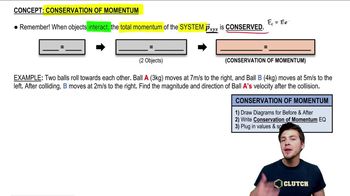
The principle of conservation of momentum states that in a closed system, the total momentum before an event must equal the total momentum after the event, provided no external forces act on it. In this scenario, the momentum of the ball and the person must be considered before and after the collision to find the final speed of the person.
Recommended video:
Guided course
05:58
Conservation Of Momentum

Momentum Calculation

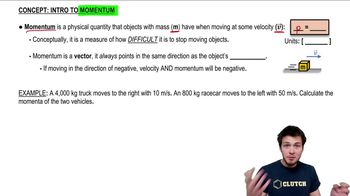
Momentum is calculated as the product of an object's mass and its velocity (p = mv). For this problem, both the ball and the person have momentum that can be calculated before and after the collision. The change in momentum of the ball will affect the momentum of the person, allowing us to solve for the person's final speed.
Recommended video:
Guided course
05:17
Intro to Momentum

Elastic vs. Inelastic Collisions

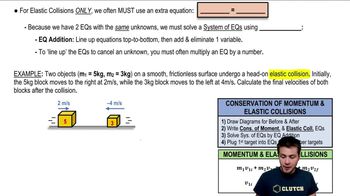
Collisions can be classified as elastic or inelastic based on whether kinetic energy is conserved. In this case, the collision is inelastic since the ball bounces off the person, and kinetic energy is not conserved. However, momentum is conserved, which is crucial for solving the problem.
Recommended video:
Guided course
08:56
Intro To Elastic Collisions
Related Practice
Textbook Question

On a frictionless, horizontal air table, puck A (with mass 0.250 kg) is moving toward puck B (with mass 0.350 kg), which is initially at rest. After the collision, puck A has a velocity of 0.120 m/s to the left, and puck B has a velocity of 0.650 m/s to the right. What was the speed of puck A before the collision?

2
views
Textbook Question

Two vehicles are approaching an intersection. One is a 2500-kg pickup traveling at 14.0 m/s from east to west (the -x-direction), and the other is a 1500-kg sedan going from south to north (the +y-direction) at 23.0 m/s. What are the magnitude and direction of the net momentum?

3
views
Textbook Question

Two vehicles are approaching an intersection. One is a 2500-kg pickup traveling at 14.0 m/s from east to west (the -x-direction), and the other is a 1500-kg sedan going from south to north (the +y-direction) at 23.0 m/s. Find the x- and y-components of the net momentum of this system.

4
views
Textbook Question

When cars are equipped with flexible bumpers, they will bounce off each other during low-speed collisions, thus causing less damage. In one such accident, a 1750-kg car traveling to the right at 1.50 m/s collides with a 1450-kg car going to the left at 1.10 m/s. Measurements show that the heavier car's speed just after the collision was 0.250 m/s in its original direction. Ignore any road friction during the collision. What was the speed of the lighter car just after the collision?

10
views
Textbook Question

On a frictionless, horizontal air table, puck A (with mass 0.250 kg) is moving toward puck B (with mass 0.350 kg), which is initially at rest. After the collision, puck A has a velocity of 0.120 m/s to the left, and puck B has a velocity of 0.650 m/s to the right. Calculate the change in the total kinetic energy of the system that occurs during the collision.

3
views
Textbook Question

You are standing on a sheet of ice that covers the football stadium parking lot in Buffalo; there is negligible friction between your feet and the ice. A friend throws you a 0.600-kg ball that is traveling horizontally at 10.0 m/s. Your mass is 70.0 kg. If you catch the ball, with what speed do you and the ball move afterward?

2
views