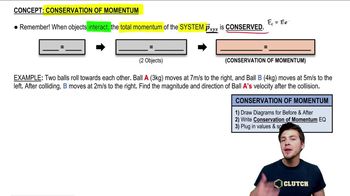
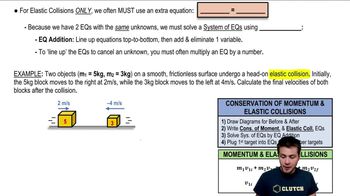
On a frictionless, horizontal air table, puck A (with mass 0.250 kg) is moving toward puck B (with mass 0.350 kg), which is initially at rest. After the collision, puck A has a velocity of 0.120 m/s to the left, and puck B has a velocity of 0.650 m/s to the right. What was the speed of puck A before the collision?
When cars are equipped with flexible bumpers, they will bounce off each other during low-speed collisions, thus causing less damage. In one such accident, a 1750-kg car traveling to the right at 1.50 m/s collides with a 1450-kg car going to the left at 1.10 m/s. Measurements show that the heavier car's speed just after the collision was 0.250 m/s in its original direction. Ignore any road friction during the collision. Calculate the change in the combined kinetic energy of the two-car system during this collision.
Verified step by step guidance
Verified video answer for a similar problem:
Key Concepts
Conservation of Momentum
Kinetic Energy
Elastic vs. Inelastic Collisions
Two ice skaters, Daniel (mass 65.0 kg) and Rebecca (mass 45.0 kg), are practicing. Daniel stops to tie his shoelace and, while at rest, is struck by Rebecca, who is moving at 13.0 m/s before she collides with him. After the collision, Rebecca has a velocity of magnitude 8.00 m/s at an angle of 53.1° from her initial direction. Both skaters move on the frictionless, horizontal surface of the rink. What are the magnitude and direction of Daniel's velocity after the collision?
When cars are equipped with flexible bumpers, they will bounce off each other during low-speed collisions, thus causing less damage. In one such accident, a 1750-kg car traveling to the right at 1.50 m/s collides with a 1450-kg car going to the left at 1.10 m/s. Measurements show that the heavier car's speed just after the collision was 0.250 m/s in its original direction. Ignore any road friction during the collision. What was the speed of the lighter car just after the collision?
On a frictionless, horizontal air table, puck A (with mass 0.250 kg) is moving toward puck B (with mass 0.350 kg), which is initially at rest. After the collision, puck A has a velocity of 0.120 m/s to the left, and puck B has a velocity of 0.650 m/s to the right. Calculate the change in the total kinetic energy of the system that occurs during the collision.
Two skaters collide and grab on to each other on frictionless ice. One of them, of mass 70.0 kg, is moving to the right at 4.00 m/s, while the other, of mass 65.0 kg, is moving to the left at 2.50 m/s. What are the magnitude and direction of the velocity of these skaters just after they collide?
Two ice skaters, Daniel (mass 65.0 kg) and Rebecca (mass 45.0 kg), are practicing. Daniel stops to tie his shoelace and, while at rest, is struck by Rebecca, who is moving at 13.0 m/s before she collides with him. After the collision, Rebecca has a velocity of magnitude 8.00 m/s at an angle of 53.1° from her initial direction. Both skaters move on the frictionless, horizontal surface of the rink. What is the change in total kinetic energy of the two skaters as a result of the collision?
