Ch 06: Work & Kinetic Energy
Young & Freedman Calc - University Physics 15th Edition
Young & Freedman Calc15th EditionUniversity PhysicsISBN: 9780135159552Not the one you use?Change textbook
Chapter 6, Problem 16a

A 1.501.50-kg book is sliding along a rough horizontal surface. At point AA it is moving at 3.213.21 m/s, and at point BB it has slowed to 1.251.25 m/s. How much work was done on the book between AA and BB?

Verified step by step guidance
1
Step 1: Identify the given values from the problem. The mass of the book is \( m = 1.50 \, \text{kg} \), the initial velocity at point A is \( v_A = 3.21 \, \text{m/s} \), and the final velocity at point B is \( v_B = 1.25 \, \text{m/s} \).
Step 2: Recall the work-energy principle, which states that the work done on an object is equal to the change in its kinetic energy. The formula for kinetic energy is \( KE = \frac{1}{2} m v^2 \).
Step 3: Calculate the initial kinetic energy at point A using \( KE_A = \frac{1}{2} m v_A^2 \). Substitute \( m = 1.50 \, \text{kg} \) and \( v_A = 3.21 \, \text{m/s} \) into the formula.
Step 4: Calculate the final kinetic energy at point B using \( KE_B = \frac{1}{2} m v_B^2 \). Substitute \( m = 1.50 \, \text{kg} \) and \( v_B = 1.25 \, \text{m/s} \) into the formula.
Step 5: Determine the work done on the book by finding the change in kinetic energy: \( W = KE_B - KE_A \). Substitute the values of \( KE_A \) and \( KE_B \) calculated in the previous steps.

Verified video answer for a similar problem:

This video solution was recommended by our tutors as helpful for the problem above.
Video duration:
3m
Was this helpful?

Key Concepts

Here are the essential concepts you must grasp in order to answer the question correctly.

Work-Energy Principle

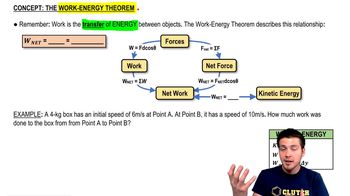
The Work-Energy Principle states that the work done on an object is equal to the change in its kinetic energy. In this scenario, the work done on the book as it slides from point A to point B can be calculated by finding the difference in kinetic energy at these two points, which is determined by the mass of the book and its velocities.
Recommended video:
Guided course
04:10
The Work-Energy Theorem

Kinetic Energy

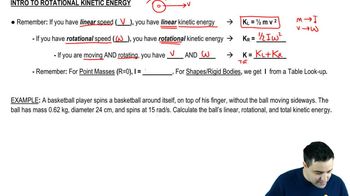
Kinetic energy is the energy an object possesses due to its motion, calculated using the formula KE = 0.5 * m * v^2, where m is the mass and v is the velocity. For the book in this problem, we will compute its kinetic energy at both points A and B to determine how much it has changed as it slows down.
Recommended video:
Guided course
06:07
Intro to Rotational Kinetic Energy

Friction and Work

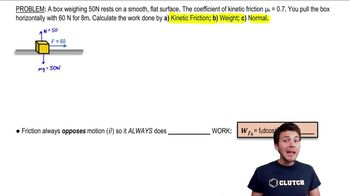
Friction is a force that opposes the motion of an object, and it does work on the object by removing energy from the system. In this case, the rough surface exerts a frictional force on the book, which contributes to the work done on the book as it slows down from point A to point B, affecting its kinetic energy.
Recommended video:
Guided course
04:29
Work Done By Friction
Related Practice
Textbook Question

A 6.06.0-kg box moving at 3.03.0 m/s on a horizontal, frictionless surface runs into a light spring of force constant 7575 N/cm. Use the work–energy theorem to find the maximum compression of the spring.

1
views

Textbook Question

A factory worker pushes a 30.030.0-kg crate a distance of 4.54.5 m along a level floor at constant velocity by pushing horizontally on it. The coefficient of kinetic friction between the crate and the floor is 0.250.25. What is the total work done on the crate?

5
views
Textbook Question

You throw a 3.003.00-N rock vertically into the air from ground level. You observe that when it is 15.015.0 m above the ground, it is traveling at 25.025.0 m/s upward. Use the work–energy theorem to find its maximum height.

7
views
Textbook Question

Two tugboats pull a disabled supertanker. Each tug exerts a constant force of 1.80×1061.80\(\times\)10^6 N, one 14°14° west of north and the other 14°14° east of north, as they pull the tanker 0.750.75 km toward the north. What is the total work they do on the supertanker?

5
views
Textbook Question

You throw a 3.003.00-N rock vertically into the air from ground level. You observe that when it is 15.015.0 m above the ground, it is traveling at 25.025.0 m/s upward. Use the work–energy theorem to find the rock's speed just as it left the ground.

2
views
Textbook Question

A factory worker pushes a 30.030.0-kg crate a distance of 4.54.5 m along a level floor at constant velocity by pushing horizontally on it. The coefficient of kinetic friction between the crate and the floor is 0.250.25. How much work is done on the crate by the normal force? By gravity?

4
views